AJ Bell’s Manager versus Machine compares active and passive fund performance in seven key equity sectors. Key findings from the December 2025 report include:
- Just 24% of active funds have beaten a comparable index tracker over 10 years, the worst reading since we launched the Manager versus Machine report in 2021
- UK active funds had an annus horribilis in 2025 as just 16% outperformed a passive alternative this year
- 2025 was a game of two halves for active managers in the Global and North America sectors
- Exposure to the Magnificent Seven continues to be a dividing line between the performance of active and passive strategies
- The Great Active Funds Exodus: £121 billion of active outflows in the last four years
Laith Khalaf, head of investment analysis at AJ Bell, comments:
“There’s no dressing it up, it’s quite simply been a dreadful decade for active fund managers. Just 24% of the funds analysed in our Manager versus Machine report have beaten a passive alternative in the last 10 years. This is the lowest reading since the report was launched in 2021.
“This has been on the cards for a while now, as year after year, active fund performance has continued to disappoint. The era of the star manager has now well and truly given way to the age of the passive machines.
“Even if active managers start to turn things around, as they seemed to be in the first half of this year, it’s going to be a long uphill battle that will require considerable and relatively consistent outperformance to make the long-term figures look less dispiriting. We have witnessed some signs of active outperformance in recent years, but they have been patchy and short-lived.
Active managers outperforming a passive alternative:
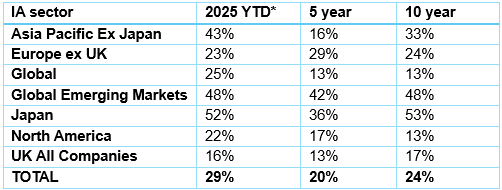
Source: AJ Bell and Morningstar, total return in GBP to 30 November 2025.
Why has the last decade been so bad for active managers?
“The dismal long-term numbers have been driven by extremely weak performance in three critical sectors: Global funds, US funds, and UK funds. One of the driving forces behind the success of passive funds across all these markets has been the outperformance of large cap stocks. Active managers tend to be underweight this top end of the market. Or to look at it another way, tracker funds are structurally overweight the largest companies in the market.
“It’s notable that in the first Manager versus Machine report published in 2021, 56% of active managers in the study outperformed a comparable index fund over 10 years. That was a much healthier picture for active managers, driven by 85% of UK active funds outperforming their passive counterparts. An astonishing number, with hindsight.
“It’s no coincidence that over the 10 year period up to December 2021, small and midcaps significantly outperformed UK blue chips, as the table below shows. That put UK active managers on the front foot, but the pendulum has now swung decisively in the other direction.
“This perspective does at least suggest the dismal run experienced by active fund managers over the last decade is heavily influenced by longstanding market conditions, rather than simply stemming from a structural flaw in active management per se. A resurgence in small and mid caps could help lift the numbers towards respectability for active managers, likewise the big blue chips coming a cropper.
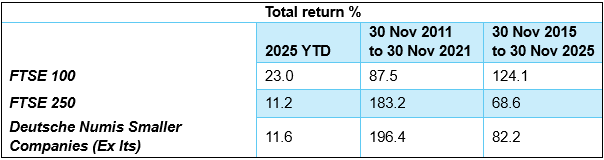
Annus horribilis for UK equity fund managers
“It’s been an annus horribilis for active UK equity fund managers, with just 16% outperforming a simple tracker fund. In this year’s market environment it’s been extremely challenging for active fund managers to outperform. Again, this comes down to large caps returning significantly more than the modestly sized companies in the UK stock market, as shown in the table above.
“Performance in 2025 was reminiscent of 2022, when UK large caps put considerable daylight between themselves and the more modestly sized companies on the London Stock Exchange. Our Manager versus Machine report from the end of 2022 found that just 13% of active UK funds beat a comparable tracker in that year. So, things could have been (a bit) worse.
A game of two halves for Global and US active funds
“2025 was a game of two halves for active managers in the North America and Global sectors. In the first half of the year the proportion of active managers outperforming in these sectors was close to a respectable 50% (51% in Global and 44% in North America).
“But the second part of the year has seen the passive machines speeding onwards and upwards, knocking huge swathes of active managers out of the race. As we approach the end of 2025, the scoreboard shows just 25% of Global active funds and 22% of US active funds outperformed their passive peers since the beginning of 2025.
“The knock-on effect of this, combined with a deterioration in the UK active fund statistics, means the proportion of active managers across all sectors who outperformed a passive alternative dropped to just 29% in our December report, down from 42% at the half year stage, as the table below shows.

The Magnificent Seven ride again, and again, and again…
“The culprits for the hot then cold performance from US and Global active funds in 2025 are not hard to round up. The Magnificent Seven technology stocks are typically held in lower weights by active funds than their passive peers, and the see-saw performance of these stocks throughout the year goes some way to explaining why active managers experienced a false dawn at the beginning of 2025.
“The chart below shows the performance of an equally weighed ETF of the Magnificent Seven stocks versus an ETF tracking the S&P 500 excluding the Magnificent Seven. Strong performance has not been universal across all seven big tech names, but the Magnificent Seven tracker has still ended up performing better than the rest of the market as we approach the end of the year, despite seriously flagging at the beginning.
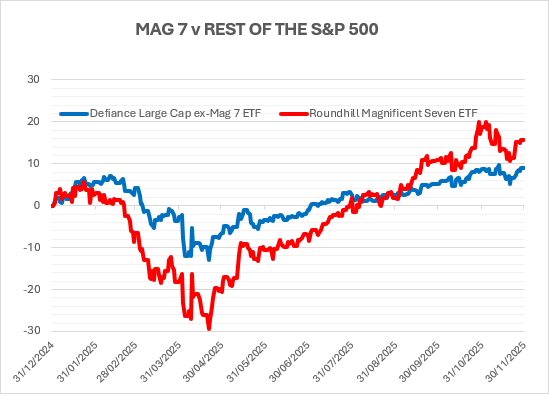
Source: Morningstar total return in GBP.
The Great Active Fund Exodus
“Future stock market historians may well characterise the period from 2022 to 2025 as the Great Active Fund Exodus. The last four years have seen £121 billion of retail outflows from active strategies, according to Investment Association data (see chart below).
“Some of this money is finding its way into index trackers. The simplicity and low costs of passive funds appeal to many investors, especially those who are relatively new to investing, or just don’t want the hassle and risk of picking active funds. That risk isn’t purely theoretical either. This report demonstrates that many active funds have underperformed over long periods, and that helps drive even more investors into the arms of the passive machines.
“But not all active outflows are being swallowed up by index trackers. A large sum has left the Investment Association funds universe entirely. Some may be leaking into adjacent investments like ETFs, single stocks, or crypto. Some may have been lured across by the appeal of cash, now interest rates are so much more attractive. Higher interest rates have no doubt prompted some homeowners to raise cash to pay down their mortgage too. And of course, inflationary pressures will have forced some investors to sell investments to cover day to day expenses.
“The tub thumping about a potential raid on capital gains tax and pensions tax-free cash ahead of the last two Budgets won’t have helped either. It’s notable that in both October of this year and last year, fund flows across both active and passive strategies were especially weak. In October of this year, £4.8 billion was withdrawn from active funds, and only £306 million went into passive funds. In October 2024, £6.4 billion was withdrawn from active fund strategies and only £632 million went into passive strategies. The government has said it’s committed to creating a more robust investment culture in the UK, but unfortunately the demoralising threat of tax rises has so far run counter to that goal.
“If you’re a glass half full kind of person, you might point to the fact that in the last two years, outflows from active funds have improved since the nadir in 2023. However with £15.3 billion of outflows so far this year, you need to be plunging your vessel into a pretty powerful punch bowl to channel such positive vibes.”
Net retail sales of active and passive funds:
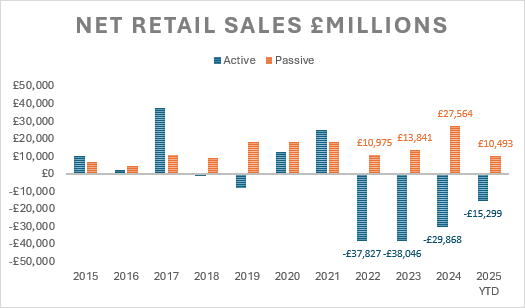
Source: Investment Association, YTD figures to 31 October 2025.