Berkshire Hathaway stops building cash but share price slide continues


Archived article: Please note that tax, investment, pension and ISA rules can change and the information and any views contained in this article may now be inaccurate.
In the three months since Warren Buffett announced his retirement plans, Berkshire Hathaway’s share price has continued to slide, perhaps suggesting that investors are yet to convince themselves the company can continue as an investment powerhouse without Buffett at the helm.
The decline in Berkshire’s share price since Buffett’s announcement on 3 May that he will retire at the end of the year is noticeable, especially in the context of the rapid rebound in the benchmark S&P 500 index.
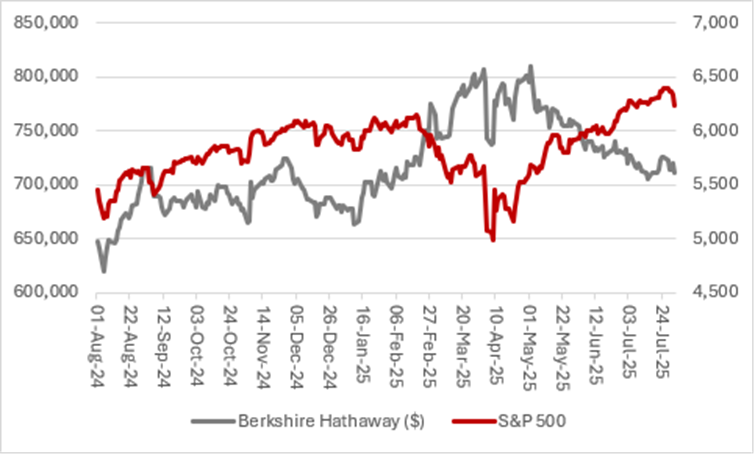
Source: LSEG Refinitiv data
Will Berkshire bounce back?
There have been periods in the past when Berkshire has lagged the S&P 500 only for its patient approach to accrue reward, and generate huge outperformance, over time.
The period 1996-1999 was one recent, and glaring, example, as Berkshire did not engage in the scramble to buy tech, media and telecom stocks, only to evade the smash that came in 2000-2003.
Performance also trailed returns from the S&P 500 in 2004-2006 when financial engineering, leverage and an alphabet soup of derivatives kept Wall Street happy until Main Street and the wider economy ended up footing the bill. Buffett and Munger pounced on the lowly valuations that prevailed after that market cataclysm and then outperformed handsomely again for the next decade.
A focus on cash
This historical pattern may provide context for the current share price swoon. The markets are giddy about the potential of AI and related companies, while meme stocks and cryptocurrencies are also hot to trot, so far as investors are concerned. Berkshire has patiently accumulated cash during the latest frenzy, in a manner entirely in keeping with its long-proven methodology of taking greater care of its money when others seem increasingly happy to speculate with theirs.
The net cash pile more than trebled to a peak of $347.7 billion in March, up from $105.4 billion in June 2022. Even the slight dip to $344.1 billion in June this year could be in-keeping with Berkshire’s style, as it may have taken advantage of April’s post-Liberation day volatility. This is the first time in the past 12 quarters that Berkshire has decreased its cash pile.
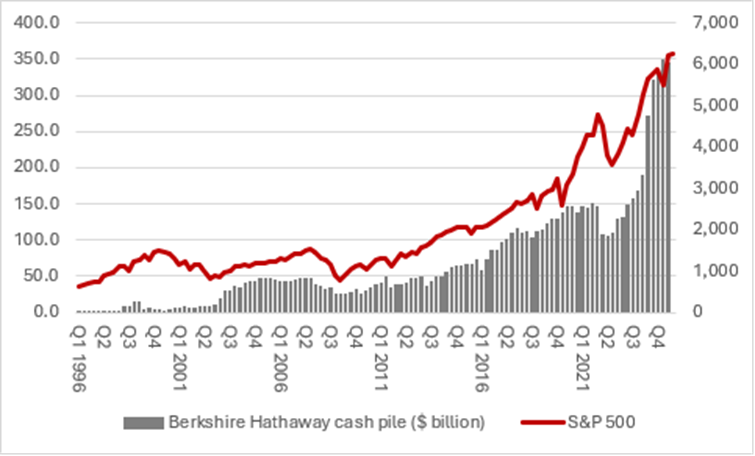
Source: Berkshire Hathaway accounts, LSEG Refinitiv data
Even so, Berkshire has markedly reduced its exposure to equities in the past three years and continued to shun the fixed-income market and US Government bonds.
Only time will tell whether the latest slide in Berkshire Hathaway’s shares is down to its investment style, which does not necessarily fit well with the market’s current preoccupation with momentum and growth stocks, or worries over how the company will do without either Buffett or Munger to guide it.

Russ Mould: Investment Director
Russ Mould is AJ Bell's Investment Director. He has a Master's degree in Modern History from the University of Oxford and more than 30 years' experience of the capital markets.
He started out at Scottish...