FTSE 100 dividend growth grinds to a halt, but buyback bonanza continues


Archived article: Please note that tax, investment, pension and ISA rules can change and the information and any views contained in this article may now be inaccurate.
While dividend growth has slowed in the FTSE 100, the index has far outpaced the US’s S&P 500 in 2025, and the pound continues to outdo the dollar.
The FTSE 100 has provided a 9.6% total return so far this year, compared to just 2.1% from the S&P 500, as the US has started to lag on the global stage.
Whether this trend continues or not remains to be seen, and the higher price for the index in combination with falling profit and dividend forecasts does take some of the shine off the appeal of the UK equity market.
The FTSE 100 now trades on a forward price/earnings ratio of 14 times for 2025. This figure is not far from historic norms, but it is still a historically large discount to the US market. The dividend yield for the FTSE 100 is now 3.5%, based on aggregated analysts’ forecasts for this year. However, share buybacks, which is when a company repurchases its own share from the market, supplement that figure.
What is the forecast for share buybacks?
Share buybacks in 2024 totalled £58.3 billion, setting a record high. FTSE 100 constituents have already declared buybacks worth £39 billion for this year, more than half last year’s total in the first quarter alone, although two – Next and Bunzl – have called a temporary halt to their schemes.
Adding together the forecast dividend total of £80.4 billion to the planned buybacks gives a total cash return of £119.4 billion, some 5.25% of the FTSE 100’s total £2.3 trillion stock market valuation. That cash yield beats inflation, the 10-year gilt yield and the Bank of England base rate.
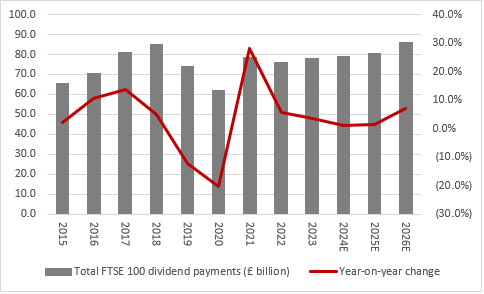
Source: Company accounts, Marketscreener, consensus analysts’ forecasts. Ordinary dividends only
No firm has declared a special dividend so far for 2025. Last year, HSBC, Fresnillo, Berkeley Group, Associated British Foods and Admiral all offered special dividends to a total value between them of £3.7 billion.
Any similar distributions could further top up the cash pot, as could any merger and acquisition activity. A predator is yet to circle a FTSE 100 member in 2025, but buyers of UK assets have tabled bids worth a total of £20 billion already this year, after £49 billion worth of successful approaches in 2024. Takeover deals can therefore also add to the total return of the UK equity market.
This matters, if you believe the old adage that bull markets only end when the money runs out, because investors are currently receiving more in cash than they are being asked to pay out. Data from the London Stock Exchange group states that companies have tapped investors for just £3.5 billion to date in 2025, via either primary or secondary offerings.
Profit forecasts start to sag
It is far from unusual for analysts to start in an optimistic fashion and then start to pare back their forecasts as a year develops. So far, 2025 fits that pattern, as hopes for a new all-time high in pre-tax profits from the FTSE 100 are starting to dissipate.
In the last three months, consensus analysts’ forecasts for the FTSE 100’s total pre-tax income have ebbed to £231 billion, down 7% from three months ago. If attained, that figure would match the 2022 peak almost to the penny.
Forecasts for 2026 have moved lower by 6% as well. The potential for tariffs and trade wars to move those numbers remains, and analysts and investors will continue to watch events in the Middle East with interest, although the manner in which BP and Shell are expected to generate one-seventh of the FTSE 100’s total earnings between them in 2025 may mean that the UK market has some kind of hedge in place, should oil spike amid gathering tension between Jerusalem and Washington on one hand and Tehran on the other.

Source: Company accounts, Marketscreener, consensus analysts’ forecasts
What sectors are surging in the UK?
Financials, oils and miners are expected to generate 55% of total FTSE 100 earnings in 2025 and to contribute 48% of total ordinary dividend payments. This perhaps reaffirms the UK’s status as a play on growth, and growth on global scale, rather than just the domestic stage.
Should inflation – and nominal GDP – ever run hot, the UK may offer a more propitious mix of sector earnings than tech-heavy America, oddly enough, as investors would be able to access plentiful cyclical, and cheap, growth and thus perhaps feel less obliged to pay top dollar (in every sense) for secular growth. Such a prospect may still seem unlikely for now, but the UK is outperforming the US in 2025 to date, and this thought process is one possible explanation why. The exposure to miners and commodities could also persuade some investors that the UK may be some sort of haven should any worries over inflation or geopolitics take over.
The UK does come with some defensive ballast, too. Healthcare, consumer staples, utilities and telecoms are expected to generate just over a quarter of earnings in 2025 and 2026, and just over one third of dividends.
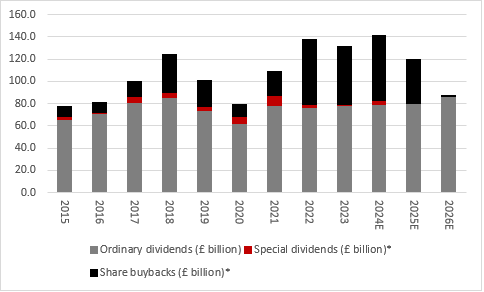
Source: Company accounts, Marketscreener, consensus analysts’ forecasts. Ordinary dividends only. *Announced in aggregate as of 20 June.
Dividend dashboard explained
Each quarter, AJ Bell takes the forecasts for the FTSE 100 companies from all the leading City analysts and aggregates them to provide the dividend outlook for each company and the entire index. The data relates to the outlook for 2025 and 2026. Data correct as of 17 March 2025.

Russ Mould: Investment Director
Russ Mould is AJ Bell's Investment Director. He has a Master's degree in Modern History from the University of Oxford and more than 30 years' experience of the capital markets.
He started out at Scottish...