How to avoid doubling up with popular funds from the same provider


Archived article: Please note that tax, investment, pension and ISA rules can change and the information and any views contained in this article may now be inaccurate.
We’ve all had the experience of finding the perfect shirt and opting to buy one in every colour, thinking that this eradicates all fashion dilemmas from our lives.
And while it is great to find a style that works for you, often you have to shop around a bit to find other options which are appropriate for other situations. For example, you’re unlikely to get your gym gear from the same shop you’re buying your work clothes from.
Investing follows a similar premise. Finding an asset management firm which invests in a way that you like or has helped generate positive returns for you is a great thing, but as our research demonstrates, simply picking the biggest funds it has to offer and calling it a day won’t actually create a diversified portfolio.
For this analysis, we took the top 10 biggest open and closed-ended active portfolios from Baillie Gifford, Schroders and Fidelity and compared how much correlation there was among the top 10 holdings.
We chose these asset managers because each one is well known for a certain investment style and all three offer some of the most popular portfolios among investors, so if you own one of them there’s a high chance you may own a second one, or are considering it.
How different providers have different ‘house’ styles
Baillie Gifford is characterised as a ‘growth’ manager, and most of its biggest funds are focused on global or US equities, giving them a bias towards big tech stocks, for example. Meanwhile Schroders is known for its ‘value’ approach, and its biggest equity funds mainly cover emerging markets. Fidelity has a more neutral house style leading to a mix of global equity (growth) and more UK and European (value) among its big funds.
Before going into each of them on a firm-by-firm basis, there are some shared threads between them all to note.
Firstly, even among these three quite different fund house styles one company was the most commonly held stock across all of them: Taiwan Semiconductor Manufacturing Company.
It was in seven of the relevant Baillie Gifford funds, five of the Schroders products, and four Fidelity portfolios, i.e. more than 50% of the funds in this study had invested in TSMC.
This alone demonstrates the point that even though funds will have different investment strategies and teams behind them they can still hold the same stocks, so it’s worth digging beneath the surface a bit to make sure you’re not holding a lot of the same things.
Baillie Gifford
Starting off with Baillie Gifford, home of the world’s second largest investment trust Scottish Mortgage, and one of the most distinctive investment styles in the industry.
The Edinburgh based group invests in companies which reinvest profits to grow value rather than those that regularly pay dividends to shareholders, a classic example being technology stocks.
This is very different to the value style Schroders is known for. Here the focus is on making returns by exploiting the market’s inefficiencies at pricing companies and buying a stock for less than what the managers think it should be worth and making a profit when the share price moves up to where it ‘should’ be.
Baillie Gifford takes the broad concept of growth investing a step further though and seeks out what is called long-term ‘exceptional’ growth stocks, companies it would describe as the market’s outliers.
Scottish Mortgage has been at the vanguard of this approach, which has seen it make early investments in Tesla and Amazon and more recently, it has been one of the leading investors in SpaceX, Anthropic and ByteDance, the parent company of TikTok, none of which yet trade on the stock market.
This very distinctive ‘growth’ style is shared across all Baillie Gifford’s funds and as a result, five companies appear in more than half of the biggest funds biggest holdings.
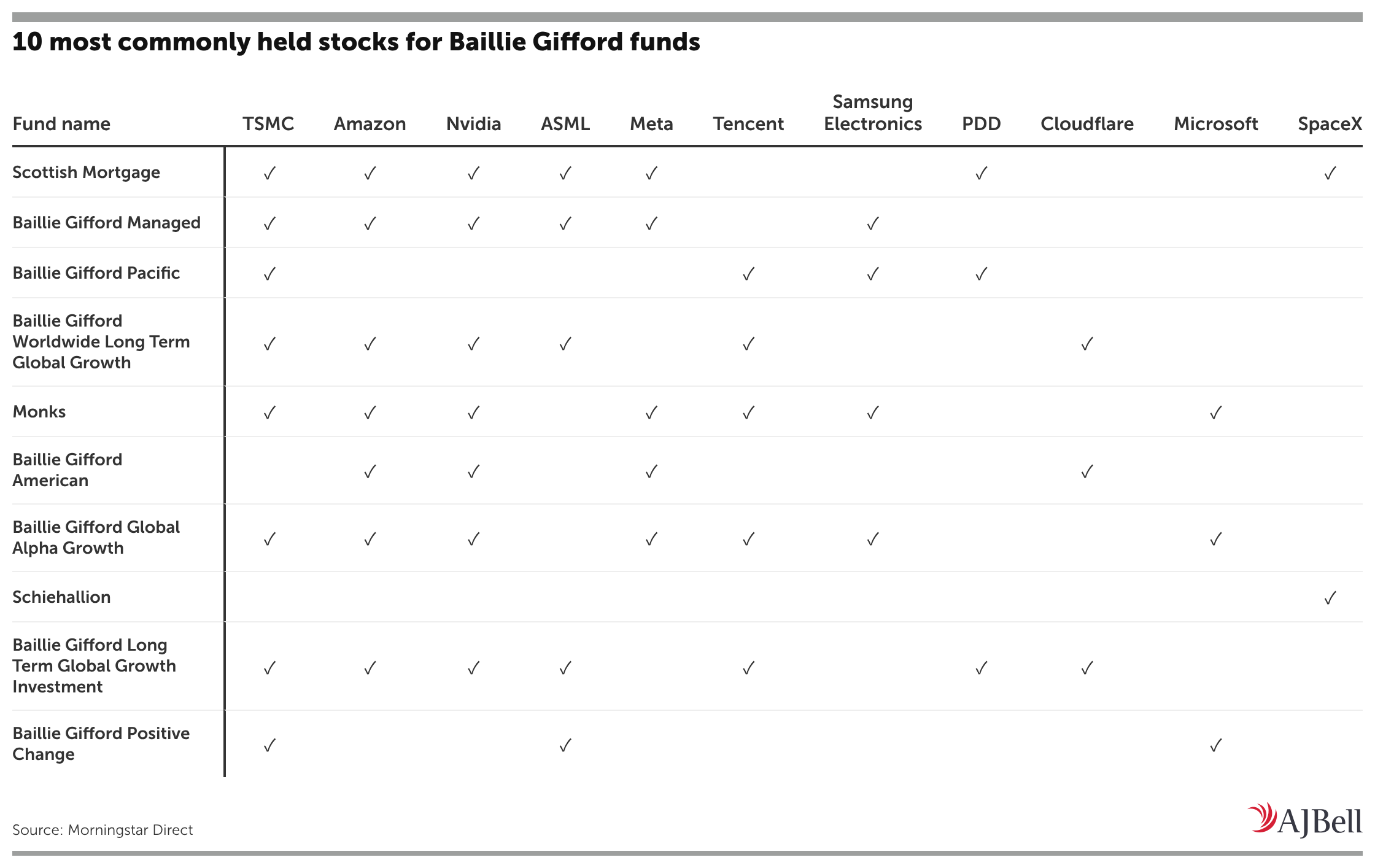
Joining the aforementioned TSMC, Amazon and Nvidia also appeared in seven funds, while ASML and Meta were in five.
The correlation came mainly from portfolios covering similar parts of the market, namely global or US equities, which seven funds explicitly covered. The diversifier of the pack was Baillie Gifford Pacific which only invests in Asian equities and therefore cannot own the likes of Nvidia, Amazon or SpaceX say.
Other correlations appeared in the portfolios which can hold private equity – Scottish Mortgage and Schiehallion – versus those that can’t, an example of the diversity available between funds from the same group.
Schroders
Turning to Schroders and as previously mentioned, it’s renowned for its value investment approach.
The Schroder Global Value Team is a specialist value investing boutique within Schroders. Made up of 10 individual running public market equity funds across a suite of UK, European, Global & International products, headed by Simon Adler who recently spoke about the value opportunity in an AJ Bell roundtable discussion.
The biggest funds here were a mix of equity only, bond only and multi-asset funds, but even so several stocks made a repeat appearance.
As mentioned above, TSMC is the most ‘popular’ company among Schroders funds as well, which is interesting given the very different house style Schroders has from Baillie Gifford.
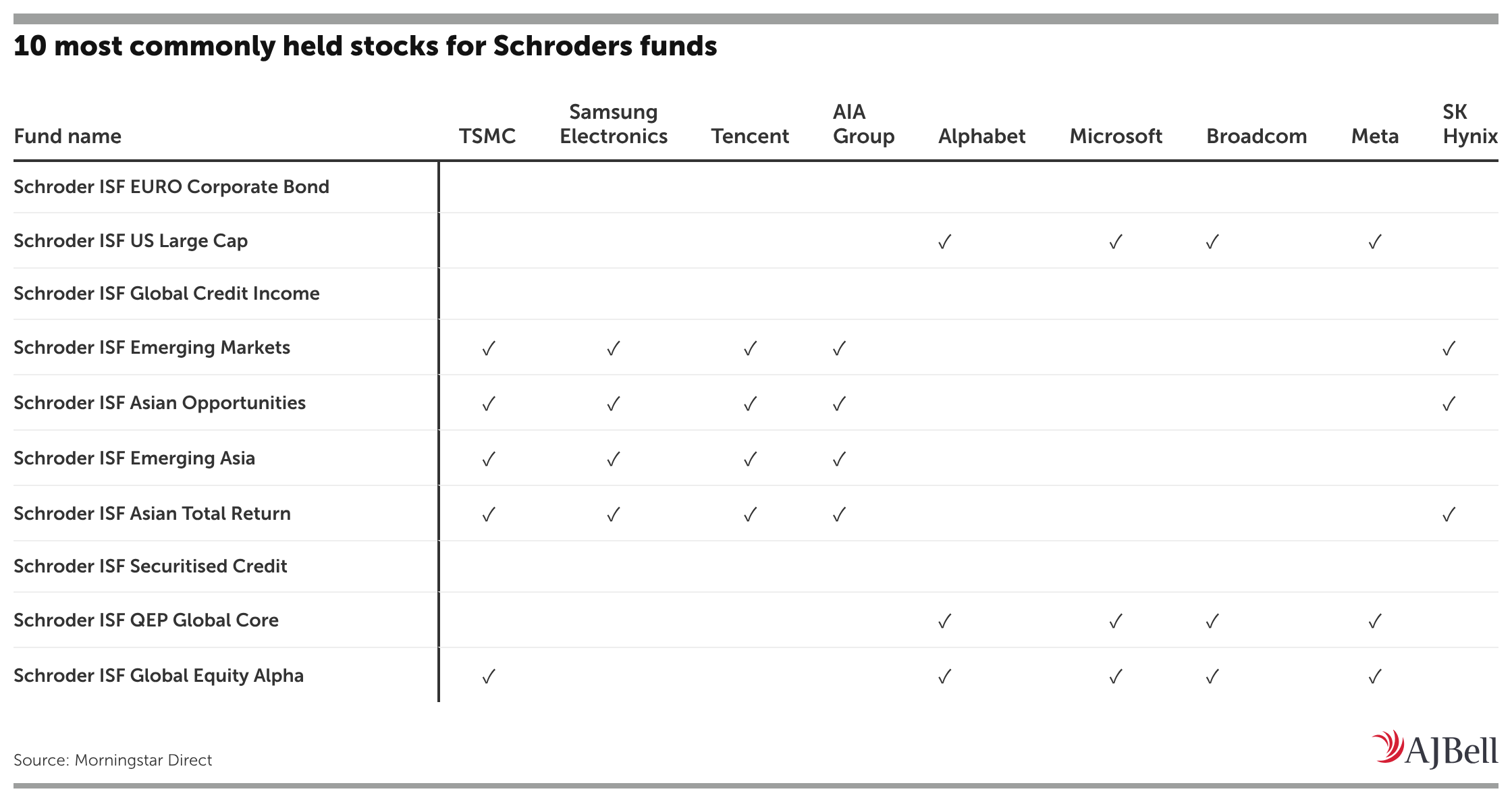
In Schroders’ case, it appeared in the Asian equity focused funds, which made sense given TSMC is based in this region.
Here the Schroder International Selection Fund Emerging Markets, Schroder International Selection Fund Asian Opportunities, Schroder International Selection Fund Emerging Asia, Schroder International Selection Fund Asian Total Return and the Schroder International Selection Fund Global Equity Alpha funds all held it.
Other widely held stocks were Samsung Electronics, Tencent and Asian insurance firm AIA Group, which were all held in four out of the 10, once again in Asia or emerging markets focused funds.
Fidelity
In Fidelity, the top funds were a mix of global technology, European equity, and UK value but still, there was a notable correlation between them.
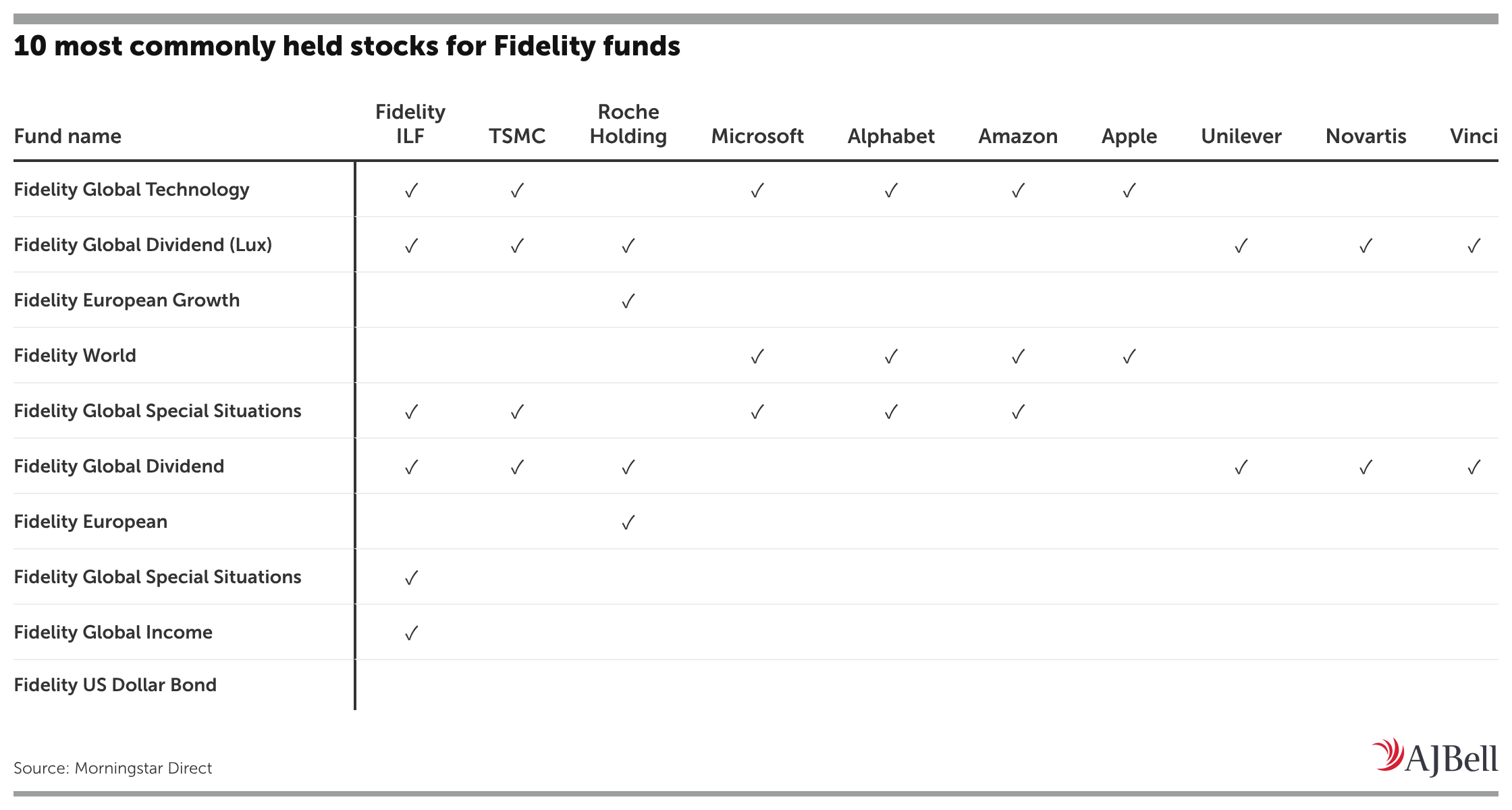
Six funds had the firm’s Institutional Liquidity in its top 10, and is a Money Market fund domiciled in Ireland which is not directly available to retail investors.
Money market funds offer is a low-risk investments holding short-term debt from governments and companies, offering slightly better returns than cash and managers will use them as a way to ‘park’ any cash so to speak, allowing the fund to benefit from a higher yield while preserving capital.
Beyond this, Roche Holding joined TSMC in four of the 10 funds, with Microsoft, Alphabet and Amazon each appearing in 3.
Many of the stocks mentioned are among the biggest and therefore most commonly held in the world so their reappearance in multiple funds is not unusual, but it demonstrates the point that when making any investment you need to check it against what you already hold to ensure you’re not doubling up.

Eve Maddock-Jones: Funds and Investment Trust Writer
Eve joined AJ Bell in 2026 as a funds and investment trust writer. She was previously editor at Investment Week, reporting on all major retail investor news, covering funds and investment trusts, ETFs and regulation...