Enjoying our articles? Choose AJ Bell as your preferred source on Google
- What is the tapered annual allowance?
- How to calculate your threshold and adjusted income
- How does the tapered annual allowance work?
- How do I calculate my reduced tapered annual allowance?
- What if I exceed the tapered annual allowance?
- How does carry forward work?
- Are there any changes to the tapered annual allowance for the 2026/27 tax year?
- The standard pension annual allowance is £60,000 for the 2026/27 tax year, but it may be reduced if you have a high income
- The taper can apply when your threshold income is more than £200,000 and your adjusted income is more than £260,000
- Your annual allowance falls by £1 for every £2 of adjusted income above £260,000, down to a minimum of £10,000
- You may be able to use unused annual allowance from the previous three tax years under the carry forward rules
The tapered annual allowance reduces the amount some higher earners can save into pensions each tax year. In particular, it can catch out people whose income varies, as well as those whose employer makes a large pension contribution – so it’s worth checking both your income and your total pension contributions before making a substantial pension contribution.
What is the tapered annual allowance?
The pension annual allowance is the amount that can usually be paid into your pensions each tax year before an annual allowance tax charge may apply. It covers contributions made by you, your employer and anyone else across all your pensions. For defined benefit pensions, it also includes the increase in the value of the benefits you have built up, measured under HMRC rules.
The standard annual allowance is £60,000 for 2026/27. But if you have a high income, the tapered annual allowance can reduce it to as little as £10,000. You will normally be affected only if both of the following apply:
- your threshold income is more than £200,000
- your adjusted income is more than £260,000
There’s more information on the criteria for these income bands further down. But if either figure is at or below its limit, the taper does not apply. It’s worth bearing in mind that other pension limits can still affect you, including the money purchase annual allowance if you have flexibly accessed a defined contribution pension.
How to calculate your threshold and adjusted income
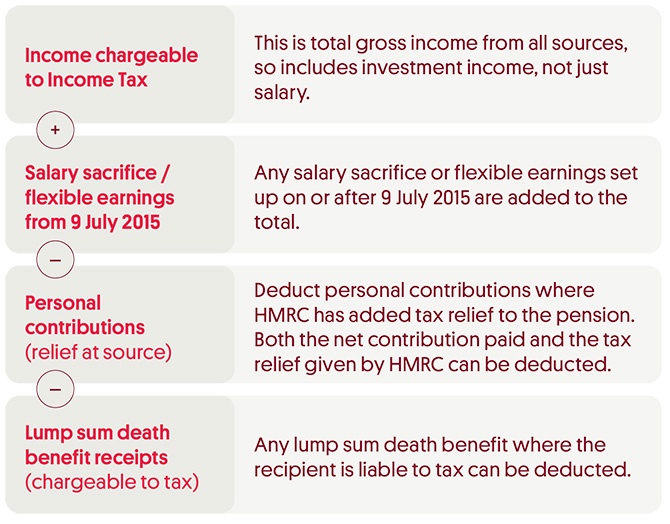
The first step is to work out if you have sufficient income to be affected. Threshold income is designed to prevent the taper applying solely because of a large pension contribution.
Broadly, you start with your total taxable income and deduct the gross amount of personal pension contributions where you receive relief at source. You would also deduct any lump sum death benefit where you’re liable for tax. Certain income given up for pension contributions under salary sacrifice or flexible remuneration arrangements set up on or after 9 July 2015 is also added back.
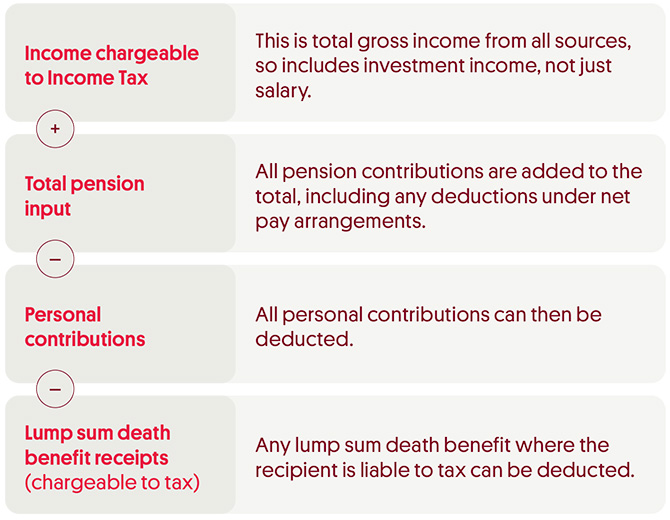
Adjusted income is broader because it includes all your taxable income ignoring any deductions for pension contributions, plus the value of any employer pension contributions. You then subtract any taxable lump sum death benefits. It means that salary or a bonus sacrificed for an employer pension contribution cannot normally be used simply to reduce adjusted income for this test.
These calculations can be complicated, particularly if you have several sources of income, use salary sacrifice, belong to a defined benefit scheme or have contributions to more than one pension. HMRC provides detailed guidance, but professional tax or financial advice may be useful if you are near either limit.
How does the tapered annual allowance work?
Once both income tests are exceeded, your annual allowance is reduced by £1 for every £2 that your adjusted income is above £260,000. The maximum reduction is £50,000.
For example, adjusted income of £280,000 is £20,000 above the limit. This reduces the annual allowance by £10,000, from £60,000 to £50,000. Adjusted income of £360,000 or more reduces the allowance to its minimum of £10,000.
| Adjusted income | Reduction | Tapered annual allowance |
|---|---|---|
| £260,000 or less | £0 | £60,000 |
| £280,000 | £10,000 | £50,000 |
| £300,000 | £20,000 | £40,000 |
| £320,000 | £30,000 | £30,000 |
| £340,000 | £40,000 | £20,000 |
| £360,000 or more | £50,000 | £10,000 |
What is the maximum I can pay into my pension?
The annual allowance is not a simple cap on what can be paid into a pension. You can contribute more, but an annual allowance charge may apply. The tax relief available on personal contributions is also limited, generally to 100% of your relevant UK earnings for the tax year. Someone with no relevant UK earnings can usually receive tax relief on gross personal contributions of up to £3,600.
Employer contributions are not limited by your earnings in the same way, but they count towards your annual allowance and are included when adjusted income is calculated. This creates a circular effect: a larger employer contribution can increase your adjusted income and reduce the annual allowance available. If you are close to the limits, ask your employer and pension providers for full contribution or pension input figures before paying more.
Do dividends count as income for the tapered annual allowance?
Yes. Taxable dividend income is included when working out your income for the taper, even if it falls within your dividend allowance and no tax is due on it. Other taxable income, including salary, bonuses, self-employed profits, rental income and savings interest, may also count. Income held within an ISA is tax free and is not included.
Do capital gains count towards the tapered annual allowance?
No. Capital gains are not income and do not count towards threshold income or adjusted income for the tapered annual allowance. However, income produced by an asset, such as dividends or rental income, can count. Selling an investment may therefore create a capital gain that is excluded, while income received from the same investment may be included.
How do I calculate my reduced tapered annual allowance?
You can check your position in four steps:
- Work out your adjusted income. If it is £260,000 or less, the taper does not apply.
- If adjusted income is more than £260,000, work out your threshold income. If this is £200,000 or less, the taper does not normally apply.
- If both limits are exceeded, subtract £260,000 from your adjusted income and divide the result by two.
- Subtract that reduction from £60,000, subject to a minimum annual allowance of £10,000.
Example
Georgina has a salary of £220,000 and investment income of £10,000 in 2026/27. Her employer contributes £50,000 to her pension and she makes a gross personal contribution of £10,000. Her adjusted income is £280,000 and her threshold income is £220,000, so both limits are exceeded. Her annual allowance is reduced by £10,000 to £50,000. As £60,000 has been paid into her pension, £10,000 is potentially subject to the annual allowance charge unless she can use carry forward.
What if I exceed the tapered annual allowance?
First check whether carry forward gives you extra annual allowance from the previous three tax years. If the amount paid in to your pension still exceeds the allowance available, the excess is added to your taxable income for the year and an annual allowance charge is calculated using the income tax rates that apply to you.
You are responsible for telling HMRC if a charge is due, normally through your self-assessment tax return. If you don’t usually file a tax return, you’ll need to register with HMRC first.
One thing to bear in mind is that you need to tell your pension scheme by the notification deadline, normally 31 July in the second tax year after the year to which the charge relates. For example, if you exceed the allowance in the 2026/27 tax year, you’d need to notify your pension scheme by 31 July 2028. Some schemes may agree to pay in other circumstances, but they don’t have to.
You may be able to ask a pension scheme to pay the charge from your pension under the ‘scheme pays’ rules. A scheme must usually offer this where your annual allowance charge for the tax year is more than £2,000 and the amount paid in to the pension in that scheme alone exceeded the standard annual allowance.
HMRC allows pension contributions to be refunded only in limited circumstances. Exceeding the annual allowance by itself does not normally allow you to reverse a contribution.
How does carry forward work?
Carry forward lets you use unused pensions annual allowance from the previous three tax years, starting with the earliest year. There’s some criteria that applies, firstly, you must first use your available annual allowance for the current tax year and secondly, you must have been a member of a registered pension scheme in each earlier year you want to use. But you don’t need to have made a contribution in those years.
If the taper applied in an earlier year, you can carry forward only the unused part of that year’s tapered allowance, not the full standard allowance. It means that the annual allowance needs to be calculated separately for each tax year.
Example
Susan has been a pension scheme member throughout the previous three tax years and made no pension contributions in 2024/25 or 2025/26. Her annual allowance for 2026/27 is tapered to £40,000. She has unused tapered allowance of £50,000 from each of 2024/25 and 2025/26, plus £42,000 from 2023/24. After using her £40,000 current-year allowance, she could potentially contribute a further £142,000 using carry forward, giving total pension input of £182,000. Her personal contributions would still need to qualify for tax relief and the usual carry forward conditions would apply.
Are there any changes to the tapered annual allowance for the 2026/27 tax year?
There are no changes to the main tapered annual allowance figures for 2026/27. The standard annual allowance remains £60,000, the threshold income limit remains £200,000 and the adjusted income limit remains £260,000. The minimum tapered annual allowance remains £10,000.
These figures have applied since 6 April 2023.
Get your money working for you
Learn more about pensions
We cover the long and short of investing in pensions, and how you could make yours stretch further.
Our pension hub
Ready to plan for your retirement with a pension account? You’ve come to the right place.
Track down any lost pensions
Our free pension finder service is available to AJ Bell customers and helps you find lost workplace pensions.
Disclaimer: Remember that the value of investments can change, and you could lose money as well as make it. We don't offer advice, so it's important you understand the risks. If you're not sure, please speak to a financial adviser. These articles are for information purposes only and are not a personal recommendation or advice. Tax treatment depends on your individual circumstances and rules may change. Pension rules apply.