


Archived article: Please note that tax, investment, pension and ISA rules can change and the information and any views contained in this article may now be inaccurate.
Related
news
20 March 2026
Not panicking, sticking to the plan and thinking about opportunities4 min readAuthor19 March 2026
Markets braced for Nike earnings as tariffs weigh on turnaround hopes3 min readAuthor
Shares Magazine
Ask the experts. Russ Mould is on hand to answer your queries about the financial markets. If you'd like a question considered for a future edition, send it in now.
I’ve been following the move higher in the gold price and the recent slump – is gold likely to remain under pressure from here?
Ken
Russ Mould, AJ Bell Investment Director, says:
With a gain of more than 200% in this decade to date, gold is proving its worth as a portfolio diversifier for investors.
That return beats global equities easily and of the major asset classes only the now-flagging Bitcoin and still-shiny silver can point to a better capital return. Even more amazingly, gold can point to a better capital return than the S&P 500 over the past 20 years (though dividends and buybacks from equities close up the gap to almost nothing).
The question now is whether this year’s gyrations in the precious metal markets are a sign of a top, or just the commodities taking a breather after a storming run.
Case for and against
Sceptics will remain firm in their view that the investment case against gold and precious metals is clear cut. They have little industrial use, certainly in the case of gold, generate no cash and thus rely on the greater fool theory for upside, as holders need new buyers to follow in and buy off them for the price to rise.
There also remains the risk that the recognised exchanges tinker with the rules if they feel matters are getting out of hand, as COMEX has just done in the US by raising its margin requirements for traders, or that government gets involved, as the Roosevelt administration did with Executive Order 6102 in 1933 that effectively forbade private ownership of any scale.
Bulls will counter by pointing to ongoing geopolitical risk, a weak dollar and galloping sovereign debts, especially in the West, where the burden is now so great that inflation and monetary debasement may be the only way to render manageable those borrowings and the associated interest bill. There is, after all, little or no political or public appetite for the sort of austerity that would be required to rein in debt growth, let alone bring about a reduction in absolute terms. The prospect of more central bank money printing, in the form of quantitative easing, at the first sign of any economic or financial market trouble is a further consideration for those will still pound the table for precious metals.
Cash flow conundrum
At this stage, valuation would be used to further frame the debate, but this is more difficult in this instance, because gold and precious metals generate no cash, an issue which comes back to why master investor Warren Buffett had no interest in them at all. He argued the metal was pretty much worthless because of its chemically inert nature. Anyone sharing that view will argue gold is worth no more than all-in sustaining costs (AISC) of production, which is around $1,800 to $2,000 an ounce, judging by recent results from major gold miners.
In the absence of multiples of earnings or a full-blown discounted cash flow (DCF) model, the bulls need an alternative approach to state their case. This can focus on the affordability of gold for would-be buyers, or a study of what it helps holders to buy, to provide a framework of relative, rather than absolute, valuation.
Supply and demand
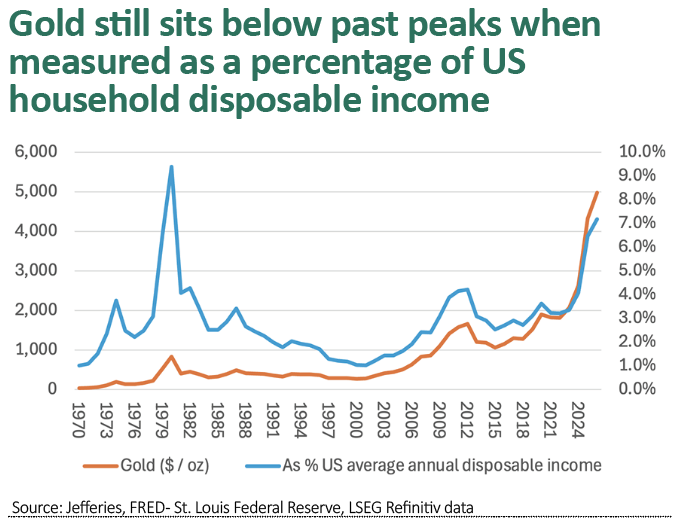
One approach is to look at how the gold price compares to annual disposable income. When gold peaked at $835 an ounce in January 1980, it reached 9.4% of the annual US household’s available annual discretionary spending. Gold currently stands at 7.2% of that figure, and a return to the former high points to a gold price of some $6,500 an ounce, or a third above current levels. Asset and wage inflation (or deflation) could shape this calculation going forward.
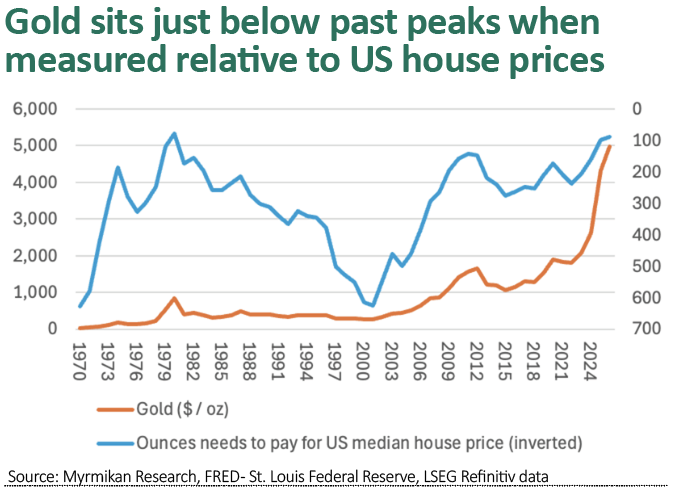
A different technique is to look at gold’s purchasing power, relative to the most important buy anyone makes – a house. A would-be buyer of the average US dwelling would currently need just 90 ounces of gold to cover the cost. This compares to the figure of 78 reached when gold peaked in January 1980. A repeat of that would take gold up by a sixth to around $5,750, again before adjusting for any future increases (or decreases) in US house prices.
One final test is to look at the value of gold relative to US money supply. This perspective rests on the debasement trade, whereby bulls of gold assert that governments will print or rely on inflation to make their debts, and spending programmes, affordable, rather than turn to austerity or higher taxes.
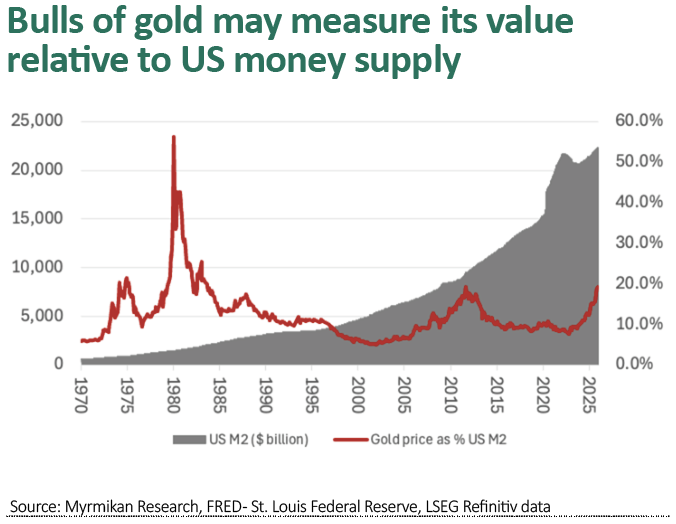
Here the conclusion is that gold is way below past peaks relative to the M2 measure of money supply in the US. A return to the 1980 high would take gold above $12,600 an ounce, although it is worth bearing in mind, in this case and the other two, that gold did not hold that zenith for long at all 46 years ago.

Russ Mould: Investment Director
Russ Mould is AJ Bell's Investment Director. He has a Master's degree in Modern History from the University of Oxford and more than 30 years' experience of the capital markets.
He started out at Scottish...