
How to distinguish genuine investment themes from ‘fads’


Archived article: Please note that tax, investment, pension and ISA rules can change and the information and any views contained in this article may now be inaccurate.
Related
news
22 July 2026
When everyone owns the same stocks, where should investors look next?3 min readAuthor
Shares Magazine
Markets are full of investment themes, the most popular of late being AI, with debates around robotics and drones abounding in conversations about the next emerging cutting-edge area.
But what actually makes something a long-term, investable strategy versus a flash in the pan frothy fad or trend?
A myriad of exchange traded fund (ETF) and thematic investment experts distilled the distinction down to several factors, but the key one was longevity.
Thinking in decades, not weeks
Joanna Smith, head of ETFs at stockbroker Peel Hunt, says trends are typically driven by headlines and hype “with popularity pushing prices and causing market momentum over relatively brief periods.”
A recent example of this was the ‘meme stock’ craze, which took off during the pandemic after short sellers co-ordinated their efforts on social media to bid up certain shares, often paying little to no regard to the sales and profits of these companies.
The most notable example was the ‘GameStop saga’ in 2021, when the flagging video game retailer saw its share price rise from $20 to nearly $500.
GameStop was a very specific market event involving a retail investor rebellion against hedge funds, but it has become emblematic of the hype-and-crash cycle of trend investing.
“Trends are often characterised by significant price swings and higher risk,” Peel Hunt’s Smith says, while Yi Shi, a manager for thematic equities at Pictet Asset Management, colloquially calls them “fads... reflecting more cyclical or time-bound developments”.
A theme on the other hand is not just looking at the next few weeks or months, but over years and even decades, underpinned often by government spending, societal shifts and viable, profitable revenue streams.
BlackRock tracks data points from academic research, patent filings, and private market funding to help them discern what products and potential themes are launchable.
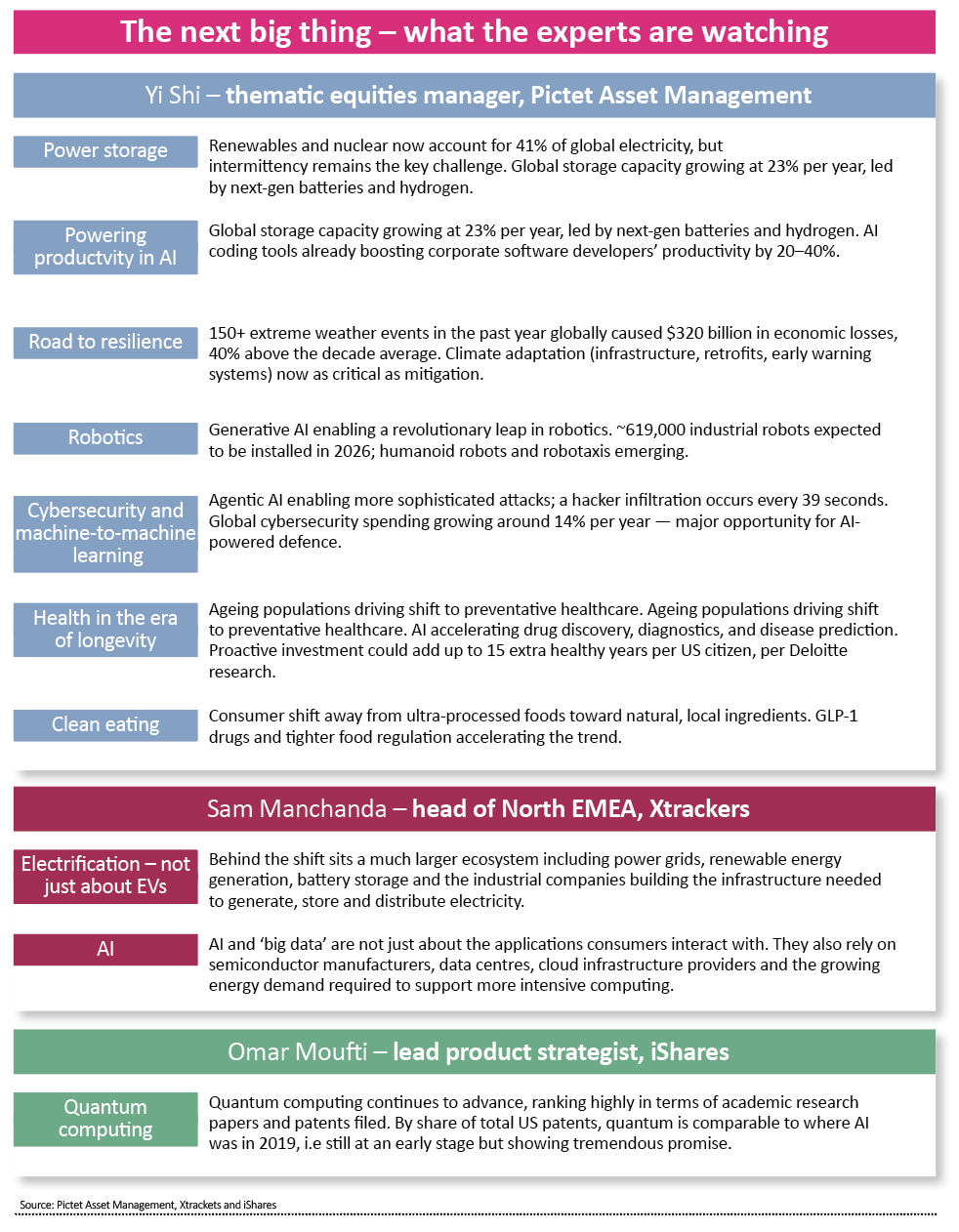
“All of this is about real-world adoption. We want to see clear evidence of basically investment, demand, and economic impact,” says Omar Moufti, lead product strategist for thematic and sector ETFs at iShares.
“An investment trend is typically something investors can see here and now. It often appears in headlines, drives short-term market moves and centres on a small number of companies attracting significant attention,” says Sam Manchanda, head of North EMEA at Xtrackers..
“Trends focus on what is winning today, while themes focus on what could drive growth tomorrow,” adds Manchanda.
Why is thematic investing so popular?
“Why do people like themes? Because we’re wired to like stories,” says Steve Wreford, manager on the Global Thematic Equities team at Lazard Asset Management.
Traditional portfolios are usually “anchored” to a region, sector, or benchmark Wreford says, “or nothing and they are just a handful or names... all methods which we think are suboptimal”.
“Anchoring a portfolio to the biggest structural changes is a very sensible way to begin the process of asset allocation,” he explains.
ETF’s role in galvanising thematic investing
Thematic ETFs are one of the main ways investors engage with the practice of thematic investing, and these vehicles have brough it to a wider audience.
“What was once a niche, expensive and time-consuming exercise is now available to a wider range of investors,” Peel Hunt’s Smith says.
“ETFs were designed to provide fast and cost-effective access to areas of the market that might otherwise be difficult for many investors to get exposure to.”
iShares’ Moufti calls this the “democratisation” of markets, how ‘you are able to apply what you see in the real world to your portfolio”.
They can also provide access to a theme which may not pass Wreford’s ‘investment pool size’ mark but could be a good future investment opportunity.
HANetf announced the world’s inaugural Ukraine Reconstruction ETF, which is “very early to market... there isn’t a defined category for how companies will generate revenue from the rebuild of the country. But we think they will in the future... but you don’t want it to come later, you want to have the product in place”, HANetf’s head of research Tom Bailey notes.
Does a flood of fund launches signal you’re too late?
When an area is popular you will often see a rush of passive products come to market. In 2025, this was evident with the ‘European Defence’ trade.
This does lead to concerns that by that point “it’s already been well picked over by the market”, Wreford says and that the smart money had already been made. But WisdomTree’s Tahir counters that there would be a very easy way to measure if this was true.
“Thematic funds would never make any assets under management increase post launch if that was the case or go on to perform well, but that isn’t the case.”
Case study – Space
One of the biggest investment themes at the moment is space, with the record-breaking IPO of Elon Musk’s SpaceX acting as a catalyst.
It’s been attached to high valuations and a bubble debate, making some wonder if ‘space’ was a niche trend or a fully fledged theme.
Wreford focuses on three criteria to determine this and, according to him, space only passes two out of three.
1. Does it tie into other themes?
“In my mind, a great theme encapsulates multiple structural changes,” Wreford says.
“It’s all very well saying there’s going to be one big thing happening in markets and buy those companies, but finding a set of stocks which participate in multiple themes that’s very, very powerful because you have multiple tailwinds and increases the return opportunity.”
“It also builds in some humility in case you get one wrong,” he adds.
Space does tie into multiple structural trends, such a technological change, supply chains, communications technology and less realised ideas such as ‘orbital commute “so it passes there,” Wreford says.
2. Time horizon
On time frames, Wreford says this is what previously relegated space to a “frontier theme”, since it wasn’t something that would generate a lot of growth over the next three to 10 years. “Now though, we’ve reached a point where you can start to have that conversation and say ‘absolutely it’s there.”
3. Enough stocks genuinely making money from this theme
Finally, you need a big enough investment pool for diversification.
AI has been a recent case study of this, with firms desperate to attach themselves to the huge amount of investment interest in ‘AI winners’.
For Lazard’s Global Thematic Focus fund, Wreford said there should be at least 10 stocks per theme able to make a “reasonable return on investment... but you want to have 20 to 30 names broadly associated with that theme, otherwise you’re just a leader for those 10 names”.
The exact number varies from manager to manager and, according to Mobeen Tahir, a member of WisdomTree’s research team, theme by theme.
Taking UCITS regulations as a given baseline, Tahir says that their strategic metals and rare earths, renewable energy or battery solution ETFs have 100 plus names, while uranium, nuclear energy and quantum computing are 40 to 50 with cybersecurity around 25 to 50.
This range can change as the theme develops but “if you don’t have 100 publicly listed, liquid companies that you can include in an ETF that are ‘pure players’ you don’t want to be diluted by putting Amazon or Google or ‘big tech’ in cybersecurity say... So you can’t set a minimum number of companies, but it’s not going to be five either”, Tahir says.
Revenue is also a key metric for determining whether stocks are really part of an investment theme or just a very niche trend.
This also has ranges depending on where a firm sits in the hierarchy of the theme, but generally, you’d want a company to be generating say 50% of its revenue. This avoids portfolios having a thematic strapline of ‘AI’ or ‘space’ say, but when you look under the bonnet it’s essentially a repackaged version of the Nasdaq 100 Tahir explained.
Going back to space, Wreford argues that while it ticks the boxes in terms of multiple structural drivers and time horizon there’s some “warranted scepticism” about the ‘investability barrier’ for public markets.
Not everyone agrees, with others arguing that space will be one of the main sources of growth and returns in the coming years, with the former heavily invested in SpaceX.
Seraphim Space Investment Trust has become a posterchild for the space economy theme, however, it is worth noting that most of the companies which the trust holds are private.

Eve Maddock-Jones: Funds and Investment Trust Writer
Eve joined AJ Bell in 2026 as a funds and investment trust writer. She was previously editor at Investment Week, reporting on all major retail investor news, covering funds and investment trusts, ETFs and regulation...