


Archived article: Please note that tax, investment, pension and ISA rules can change and the information and any views contained in this article may now be inaccurate.
Related
news
15 December 2025
The best way to get the UK investing is education not Cash ISA cuts3 min readAuthor
Shares Magazine
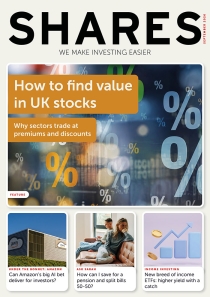
In this article we’re on the hunt for shares which are trading at valuations which are significantly lower than they have historically traded on.
To do this we have screened for companies trading at a discount to their average 10-year forward PE or price to earnings ratio.
The forward PE ratio is a stock valuation measure that uses a company’s projected earnings. It is calculated by dividing the current stock price by analysts’ EPS (earnings per share) forecasts for the next 12 months.
This valuation metric has an advantage over the trailing PE because it incorporates the market’s expectations for a company’s future earnings potential. The downside is that analysts’ forecasts can be wrong.
Despite these limitations, the forward PE can be a useful measure to screen for companies trading at a discount to their long-term average, unearthing potential candidates for further research.
Why are PE ratios volatile?
The large swings seen in PE ratios are typically linked to the price component of the ratio.
Over the short term, investor sentiment can have a significant impact on the share price, while the earnings component has more influence over longer timeframes.
The interplay between these two effects can drive PE ratios some distance from their long-term average.
It is important to note; there is no guarantee PE ratios will move back to the average. However, assuming a business has not changed too much, the average PE can act like a magnet, pulling the ratio back to the norm.
Shares has used ShareScope software to screen for FTSE 350 stocks with a forward PE at least 30% below the 10-year average. Bear in mind that implicit in adopting a 10-year period is a long-term focus.
Which stocks are trading on the steepest PE discounts?
Specialist media platform Future stands out for a few reasons, not least because its forward PE is sitting a substantial 66% below its 10-year average.
On more than one occasion since the late 1990s Future has been treated as a ‘stock market darling’ growth story.
The period from 2017 to 2022 saw Future become a high-growth consolidator of specialist media titles, driven by multiple acquisitions.
This momentum and growth narrative pushed the PE to around 28 times at the peak in late 2021.
The stock got caught up in the sell-off of highly valued shares in 2022 driven by the sharp increase in interest rates as the Bank of England responded to rising inflation.
This period coincided with a slowdown in digital advertising and investor concerns over the performance of Future’s core businesses, which led to the stock’s de-rating.
The shares now trade on a mid-single digit PE suggesting Future days as a growth business may be behind it.
Though the promise of a return to modest growth in the year to 30 September 2026 delivered alongside full-year results (4 December) did at least give the market a modicum of encouragement.
Multi-brand fashion company and ‘King of Trainers’ JD Sports Fashion has also fallen from grace as a dependable growth company amid multiple profit warnings and heavy discounting.
The shares trade around two thirds below their 2021 peak, and the forward PE is under half its 10-year average.
In a third-quarter trading statement on 20 November the company said it was taking a ‘pragmatic’ approach ahead of the peak festive trading period.
Management guided for full year pre-tax profit to be at the lower end of the current consensus range of £853 million to £888 million, implying a 7% year-in-year fall.
Analysts expect JD Sports to get back to growth over the next few years in line with the firm’s ambition to open 200 new stores a year and achieve an operating margin exceeding 10% by 2028.
How swings in earnings can impact a PE
It might seem surprising to see FTSE 100 oil company Shell trading at a 45% discount to its 10-year average forward PE, but this reflects the highly volatile nature of earnings in the oil and gas sector.
Weak oil prices translated into years of low profit in the wake of the oil price crash in the mid-2010s and during the pandemic which led to a spike in the PE ratio. Meanwhile, in the boom couple of years seen after the invasion of Ukraine the PE was driven down to a low single digit value as earnings forecasts were rapidly upgraded and the share price didn’t keep pace.
For companies like Shell, it is more meaningful to look at the median PE which excludes outliers. On this basis the PE is 13.4 times, reducing the discount to 17%.
Premium drinks company Diageo saw its shares drop to 12-year lows recently, pushing the forward PE nearly 40% below its 10-year average.
Diageo has suffered from combination of headwinds including a post-covid spending hangover, weakness in the US and China, a profit warning due to oversupply issues in Latin America and changing consumer habits.
One piece of news which was well received by investors is the recent appointment of former Tesco chief executive Dave Lewis as the new CEO.
Lewis has some strengths to work with to engineer a turnaround. Diageo possesses a collection of iconic brands like Johnnie Walker, Guiness and Smirnoff and enjoys global scale advantages.
The UK’s leading pizza group Domino’s Pizza has faced significant headwinds from the cost-of-living crisis as consumers cut back on discretionary spending.
The shares trade close to 12-year lows and the forward PE is 43% below its 10-year average.
Domino’s franchisees have faced significant cost increases, resulting in the company recently slowing the pace of new store openings.
Despite these hiccups, Domino’s has not abandoned its ambition to grow its estate to 1,600 stores by 2028 and 2,000 by 2033, generating £2.5 billion of system sales.

Martin Gamble: Shares and Markets Writer
Martin Gamble is Shares and Markets writer at AJ Bell. He was previously the Education Editor of Shares Magazine. He has been with the business since 2019.
Martin graduated from the University of Kent in...