


Related
news
Shares Magazine
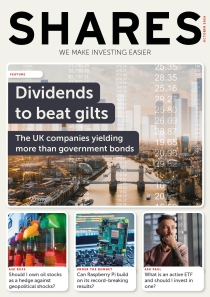
Ask the experts. Russ Mould is on hand to answer your queries about the financial markets. If you'd like a question considered for a future edition, send it in now.
Or alternatively leave a rating for the article and include your question in the comment box.
With tensions in the Middle East pushing up energy prices, should I consider adding oil and gas stocks to my portfolio as protection if inflation and market volatility return?
Len
Russ Mould, AJ Bell Investment Director, says:
Seven months after the first strikes on Iran, the Revolutionary Guard are still in power and the Straits of Hormuz in the Persian Gulf are effectively closed. Now, another chokepoint, the Straits of Bab al-Mandab that lead from the Gulf of Aden to the Suez Canal and then the Mediterranean, are under Houthi pressure, even as Saudi Arabian pipelines face attack.
As a result, the price of Brent crude oil for one-month delivery is up by a nearly 50% since the start of the conflict and European gas prices are up by 150% to their highest mark since late 2022, even if the US Henry Hub natural gas benchmark is broadly flat.
Thus far, stock markets have taken this in their stride, in the view that April’s peace deal and then June’s Memorandum of Understanding between Washington and Tehran signified an end to military escalation the start to de-escalation, with a final, peaceful agreement the logical end game.
However, bond markets are far from happy, and commodity markets are buoyant, so perhaps markets may need to reassess their views, especially with regard to the unfashionable energy sector that could yet provide a valuable hedge against any worst-case scenarios.
Bear case
Bear cases look at their most compelling when they confirm a long-term price trend and, in this respect, it is easy to write off hydrocarbons as a bad job, given how the all-time peak price for crude oil dates back to 2007 in nominal terms, let alone inflation-adjusted ones, respectively.
The inability of oil to challenge its prior high feeds the bearish narrative. This rests upon:
The ongoing drive toward renewables and away from hydrocarbons to the detriment of demand. International Energy Administration forecasts of plentiful long-term supply despite near-term disruptions.
The entirely understandable assertion that the best cure for high prices is high prices, so that demand destruction or even more supply will follow in the event of a sustained price spike.
Traders are acting. They continue to build up short positions against the commodity, elongating a trend that dates back three years.
Bull case
As the conflict with Iran drags on longer than thought, America is doing its best to keep a lid on oil, and thus gasoline, diesel, and heating oil prices ahead of November’s mid-term elections by releasing supply from its Strategic Petroleum Reserve.
But America’s reserves are dwindling and at some stage must surely be replenished, if only to protect it from any further possible energy-related geopolitical shocks. Nor would it be a surprise were Tehran to be closely watching the weekly inventory data kindly published by the US Energy Information Administration with the same mid-term ballot in mind as it seeks leverage in its negotiations with Washington.
There is a risk that oil traders are looking at crude oil supply, but missing the issue of demand, which remains strong, judging by how crack spreads remain elevated.
Crack spreads measure the difference between the price of a barrel of crude and the price of the products refined from it, and the high spreads usually mean refiners are worried about future supply of crude relative to demand for petrol, diesel, jet fuel, heating oil and more. The US diesel crack spread stands at a record high, north of $100 a barrel, while the global 3-2-1 crack spread, which measures the difference in price between three barrels of crude, against two of petrol and one of heating oil, is up more than threefold in 2026 to date. An alleged glut of crude oil could yet turn into a squeeze on refined product supply.
Price tags
A speedy peaceful resolution to US-Iran conflict could take the sting out of these considerations, but there are no guarantees of that. Even though the world is less reliant on oil now, the alternative scenario conjures up bad memories of the stagflation of the 1970s, when equities, bonds and cash were all terrible performers and commodities proved the best store of value.
Nor are stock or commodity markets prepared for rising energy prices, even if bonds are paying attention. The energy index remains near all-time lows as a percentage of total, global stock market capitalisation, even though Covid, Ukraine and Iran are reminders of the importance of natural resources and supply chains as part of wider national security concerns.
There is another way to look at this. Artificial intelligence enabler and silicon chip designer Nvidia is currently the world’s most valuable public company with a market capitalisation of $5.5 trillion. They may be less aware that for the same price tag they could buy the West’s seven oil and gas majors nearly three times over.
Investors could be forgiven that unloved oil stocks could offer some protection from any further nasty surprises in the Middle East, even if they agree with economist Joseph Stiglitz’s assertion that “the only perfect hedge is in a Japanese garden.”

Russ Mould: Investment Director
Russ Mould is AJ Bell's Investment Director. He has a Master's degree in Modern History from the University of Oxford and more than 30 years' experience of the capital markets.
He started out at Scottish...