


Related
news
19 August 2026
Can fund managers really ignore where the companies they invest in are based?6 min readAuthor
Shares Magazine

How long do you persist with an investment that isn’t working out. It’s often one of the hardest questions for investors to answer and a conundrum most of us will have wrestled with at some point.
I’m not talking here about periods of short-term volatility or market corrections when there is a strong argument for holding your nerve in the face of wider panic, as we have discussed in these pages before. Instead, this is about the investments which have consistently disappointed on a longer-term basis.
It can be frustrating having done your research and convinced yourself of the merits of a particular fund or share to see the market take not a blind bit of notice and leave your holding languishing for long periods.
Yet as John Maynard Keynes observed, “markets can remain irrational longer than you can remain solvent” or in other words the pain of holding on to a losing position in the hope or expectation it can turn around can eventually tell. Crystallising a loss can feel painful too but at a certain point you may have to admit defeat and accept the hit as a necessary prerequisite for putting your money to work in a more fruitful fashion.
What to think about with a fund
But when and how do you decide it’s actually time to move on and call it quits? First, it’s worth saying that the decision-making process will have differences depending on whether we’re talking about a fund or a stock.
With a fund, you would certainly want to look at performance through a long-term lens. Crucially, you’d want to think about the role it is playing in your portfolio. It might for example be generating less racy returns than more fashionable holdings but if it is offering some stability that might still be useful to you.
If a fund consistently underperforms over a long period and the manager shows little sign of being able to address the weak performance then that can certainly be a reasonable cue to cut your losses.
In my view it’s even more of a spur to hit the sell button if there is a big shift in the investment philosophy which attracted you to the fund in the first place. Ideally you don’t want managers who sway with the wind but ones who will stay the course in the hope and expectation this consistency will pay off in the long run.
With a share, again a dramatic shift in strategy can be a cue to reassess. But a plunging share price isn’t an automatic reason to sell a great company, so long as the investment case remains intact and the business has just encountered a short-term speed bump.
Asking tough questions
You should ask yourself some tough questions, such as has the fundamental investment thesis changed, are you simply reacting to a share price fall, and is it worth monitoring the stock a little longer to see if your continued confidence is justified?
What investors are often waiting for is a catalyst which can help drive an improvement in the share price. This could be a marked improvement in trading, a change at the top, a major contract win or the announcement of a credible recovery plan.
The flow chart below could help give you a rough framework to base your decisions on.
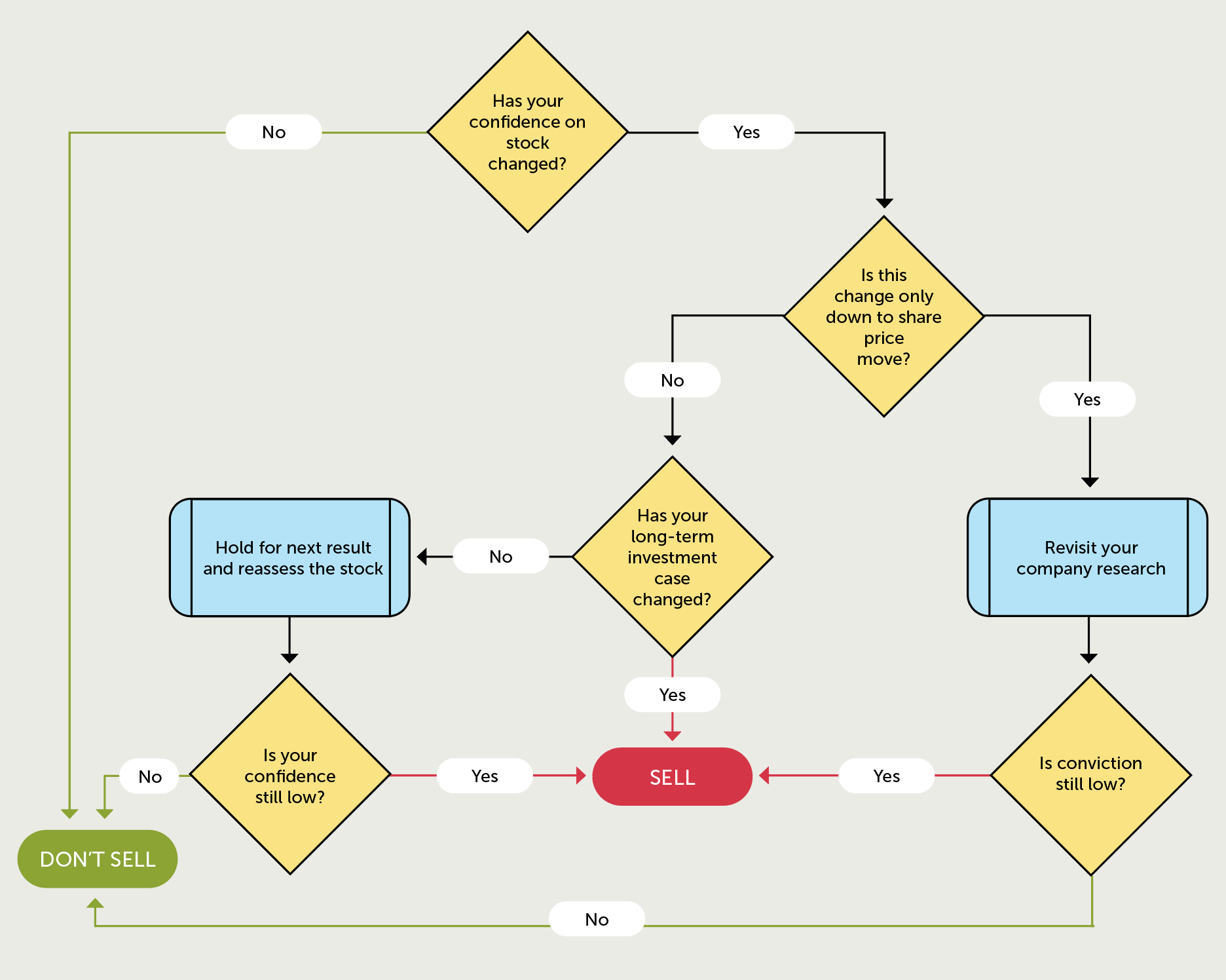
Valuation, the trajectory of profit and cash flow, a company’s M&A strategy, a change of management or even just the emergence of more compelling opportunities elsewhere are all reasons you might reconsider an investment. Just make sure it’s a considered decision not one made in haste.

Tom Sieber: Content Editor
Tom Sieber is AJ Bell's Content Editor. He was previously the Editor of Shares Magazine. He has been with the business since 2012.
Tom is a regular contributor to the AJ Bell Money & Markets...