

Archived article: Please note that tax, investment, pension and ISA rules can change and the information and any views contained in this article may now be inaccurate.
For many investors dividends are a good source of income, but they can also be a good source of capital growth. Long-term studies have shown that dividends have contributed more than half of the stock market’s total return.
This shows that reinvesting dividends is crucial for maximising shareholder returns and compounding wealth. Even for investors primarily interested in dividends for their income, growth in the dividend is an important consideration because of the effects of inflation.
For example, if inflation were to run at 3% a year over the next decade it would erode how much ‘stuff’ your income could buy by around a third. Therefore, it is important that dividend income rises at least in line with inflation to maintain your standard of living.
This article identifies FTSE 350 companies which have grown their dividends per share at a compound annual growth rate of at least 10% a year over the last decade.
Why is dividend growth important?
While high yielding stocks offer immediate income, they are often paying out a large proportion of their profits in dividends.
This is referred to as the payout ratio, calculated as annual dividend per share divided by earnings per share, expressed as a percentage.
For example, the UK’s largest company by market capitalisation AstraZeneca reported earnings per share of 535p in 2024 and paid out dividends per share of 307p, which is a payout ratio of 57.4%. Its dividend yield is 2.3% based on the current share price.
Companies which can increase dividends every year for decades (often called Dividend Aristocrats) often possess a durable competitive advantage.
This protects a business from the ravages of competition and allows it to generate strong cash flows and fund a growing stream of dividends.
A hidden wealth builder
Investors may turn their nose up at the skinny yields on offer with dividend growers, but over time, higher dividends down the line can really add up.
One popular way to think about this is to calculate the yield on cost, which compares future dividends with the initial cost price.
For example, a company paying a 2p per share dividend with the stock price at 100p has an initial yield of 2%. (2 divided by 100 x 100)
If the dividend grows at 10% a year over the next decade it will grow to 5.2p, giving a yield on cost of 5.2%. Over 20 years the yield on cost would grow to 13.5%.
The table below shows the best dividend growers in the FTSE 350 over the last decade, based on data from ShareScope. Remember, past growth rates are not necessarily a guide to what you can expect the future.
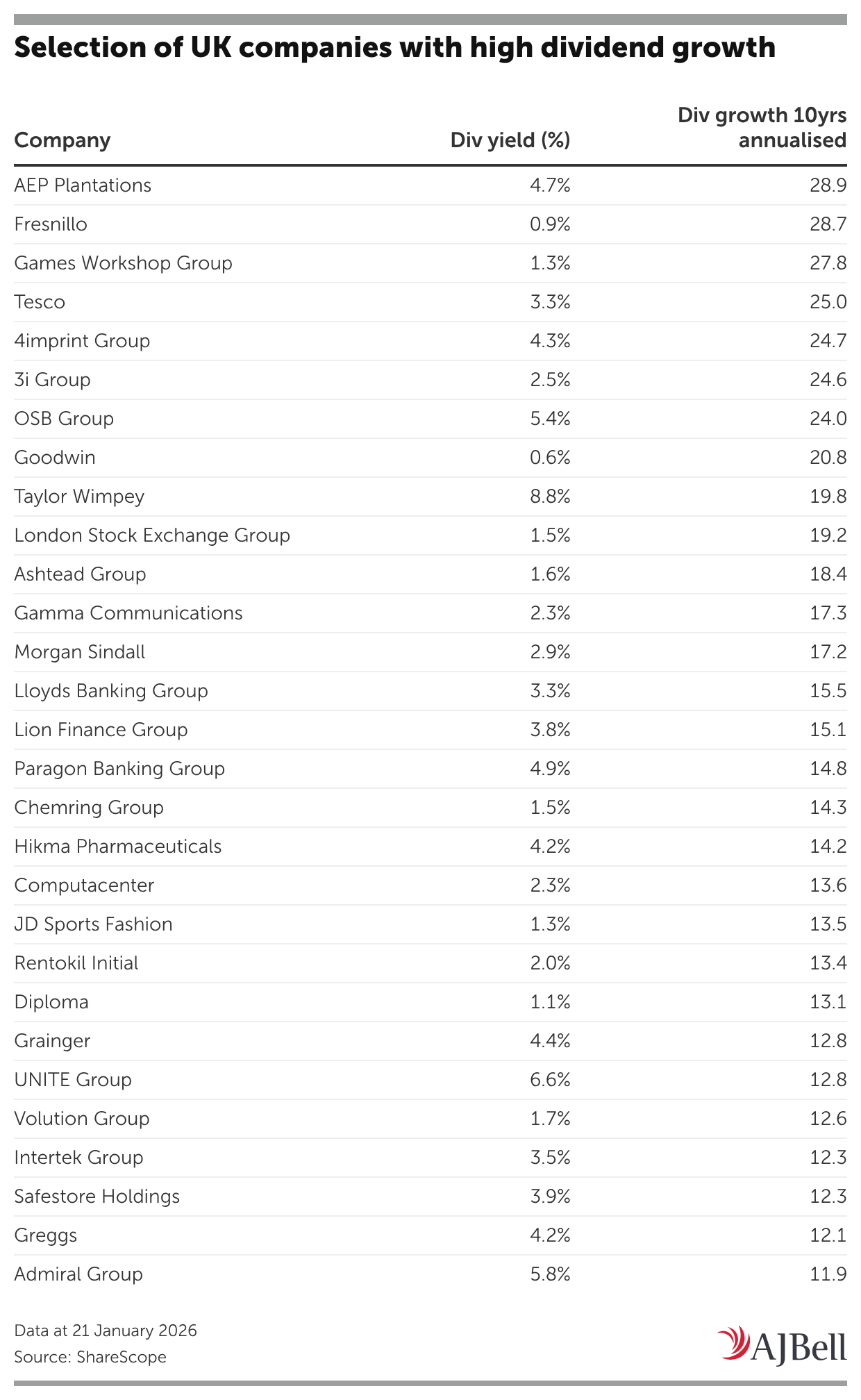
Fantasy miniatures maker Games Workshop has been one of the most successful listed companies on the London stock exchange. In 2024 the shares were promoted to the top-flight FTSE 100 index.
The company has always been very clear about its policy to return excess cash to shareholders alongside regular, progressive dividends.
Games Workshop has arguably built a formidable economic moat as the leading premium maker of tabletop games.
The UK’s leading grocer Tesco is perhaps a surprise entry in the list of high dividend growers. This is due to the dividend being slashed in 2014 amid an accounting scandal, which reduced the base and flatters the growth rate.
Today, Tesco has a progressive dividend policy, paying out half of earnings and has committed to a further £1.45 billion buyback by April 2026.
The rebasing effect has similarly distorted the growth rate for Lloyds Bank, which tentatively resumed paying dividends just over a decade ago.
Insurer Admiral is considered one of the best operators in the UK car market where benefits from a lower loss ratio (incurred losses to total premiums) than its competitors.
The company pays out 65% of annual post-tax profits in dividends plus a special dividend comprised of cash not needed for regulatory solvency purposes.
Admiral is aiming to replicate its success in motor insurance in the pet and home insurance markets.

Martin Gamble: Shares and Markets Writer
Martin Gamble is Shares and Markets writer at AJ Bell. He was previously the Education Editor of Shares Magazine. He has been with the business since 2019.
Martin graduated from the University of Kent in...