

Archived article: Please note that tax, investment, pension and ISA rules can change and the information and any views contained in this article may now be inaccurate.
If you’ve been keeping an eye on your investments in the past few weeks, you may have experienced a nasty shock. Despite all the work you’ve put into creating a diversified portfolio, the market turmoil of March may have put a dent in your investments.
This isn’t a reason to panic. Even well diversified portfolios aren’t immune to falls in the market. The goal is to reduce mountains of turmoil in the broader market to molehills in your portfolio.
But some investors might be facing larger drops than expected, which can be a sign that your portfolio isn’t as diversified as you might have believed. In this case, taking the opportunity to review your holdings and ensure that you have true diversification, not just a lot of investments, can help.
Sneaky similarities
The key to diversification isn’t just investing in a bunch of different stocks or funds. With funds, in particular, it’s examining what each of those investments hold, and what they are sensitive to. We find that many investors hold multiple global funds that track indices. But within these funds, you are likely holding a similar group of companies in two different baskets. When one falls, the other will do the same, which doesn’t do much for diversification. It just means more trading fees by holding additional funds.
You can do a quick check of this by using AJ Bell’s X-ray tool. This gives a breakdown of exposure across all the investments held in that account, so you can see which areas you have more, or less, exposure than you’d like. From there, you can dig into the details of the funds to figure out where the over exposure is coming from.
Spotting funds holding the same companies is the easiest way to root out illusions of diversification in a portfolio, but it’s not the only thing to look for. When we aim to diversify a portfolio, at the core, we are looking for investments that react differently to similar risks. So, if you have a portfolio of companies that are very different businesses, but are sensitive to the same risks, this can create a problem.
For example, many investors have growing concerns about the price of AI companies, so may look to diversify to other areas. But if they are picking industries with direct links, such as the companies responsible for building data centres, the trickle-down effects of a downturn in AI would mean those industries are harmed as well, because it could diminish their revenue.
Investors can also fall into the trap of overexposure to currency risk. This isn’t always simple to see, because the country where a company is registered isn’t always where they do most of their business. This creates the risk of exposure to another country’s currency which goes unnoticed by you as an investor. Many businesses in the FTSE 100 derive the majority of their revenue overseas, like, for example, HSBC, which does most of its business in Asia.
For stock selectors, grasping these risks takes digging and a comprehensive understanding of the company, where they do business, and what businesses they work closely with. Funds will typically break this information down into a more digestible format.
The task of true diversification
When we look to diversify our portfolio, we are aiming to reduce the correlation between our assets. In this instance, correlation measures how often two assets move in the same direction, and at what rate. So, if Asset A always goes up and down at the same time and the same amount Asset B does, this would be a correlation of one. If Asset A went down but Asset B stayed the same, this would be a correlation of zero.
The idea is that if you hold assets that have a low correlation, or an inverse correlation, your portfolio will have less volatility because your assets don’t react to the same factors. But it’s quite difficult to create a portfolio where the assets have no correlation, because they are dealing with the same global environment.
A popular way to create diversification used to be holding 60% of your portfolio in equities (stocks and shares) and 40% in bonds, because bonds tended to perform better when equities fell, creating a nice inverse relationship. But this case has blurred in recent years, with bonds often moving in tandem to equities. This has led other assets, such as gold, to rise in popularity as people attempted to create further diversification.
However, for investors that are comfortable with risk, diversification can be found without having to look outside equities. Certain funds will structure their investments specifically to be unaffected by geopolitical or other macro events. They do this by making a combination of regular investments and taking out ‘shorts’ against some companies, meaning that the fund makes money when the share prices of those investments decrease. By holding a mix of these regular investments and short positions, they design the fund so that it is relatively unaffected by changes to the broader environment, which is called ‘market neutral’. The Premier Miton Tellworth UK Select fund takes this approach and has an extremely low correlation to the MSCI World, but invests in household names such as Barclays, HSBC and Imperial Brands.
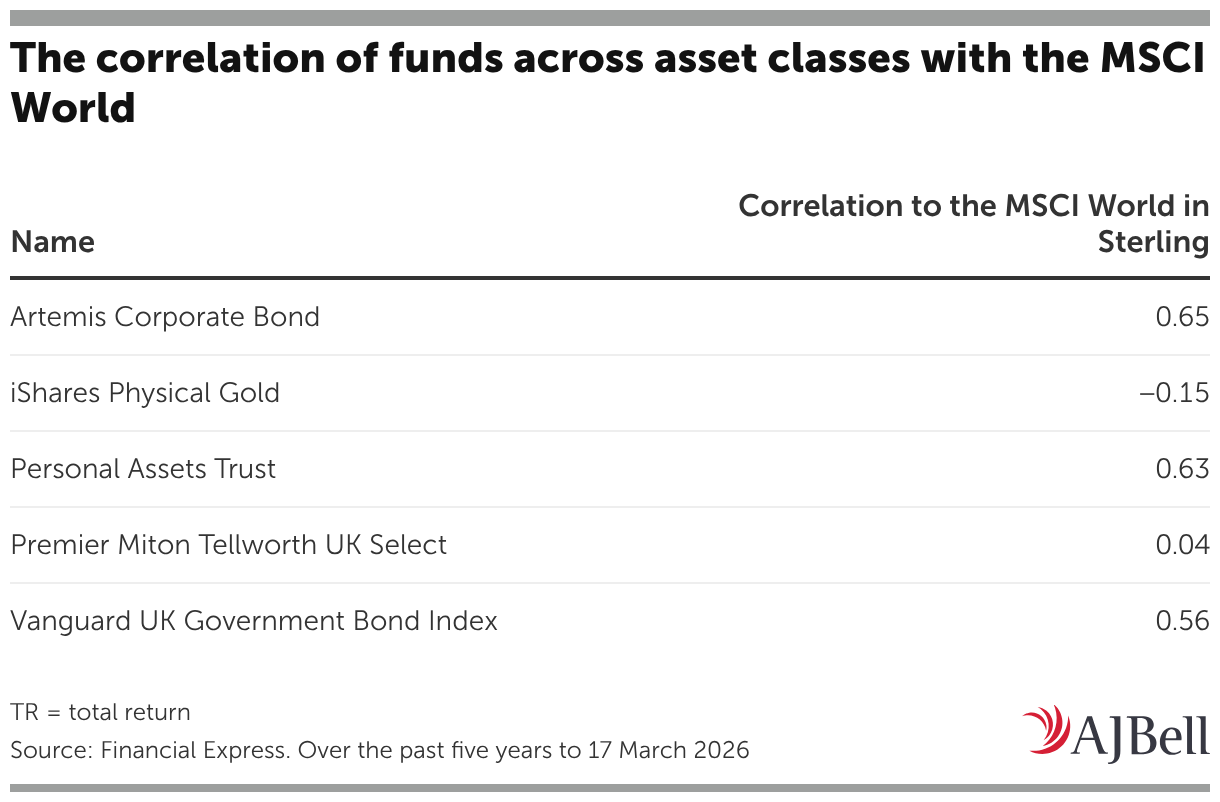
What does all this talk about correlation mean? Despite still investing in equities, the Premier Miton fund will likely not follow dramatic drops that happen in the MSCI World, providing good diversification for investors who hold both. While iShares Physical Gold has a slightly negative correlation, meaning it’s more likely to go up when the MSCI World goes down.
Diversification will look different for everyone, depending on their level of comfort with market volatility. Bonds still typically offer a smoother ride that equities and gold don’t provide, even though they aren’t closely matching the MSCI World. So, before getting caught up in creating a portfolio of perfectly curated corelations, consider your comfort level. A well-diversified portfolio won’t do you much good if you’re constantly pulling money out of the market after a downturn. Creating an investment ride that you’re able to stay on without losing sleep at night is the top priority.

Ryan Hughes: Managing Director of AJ Bell Investments
Ryan Hughes is AJ Bell's Managing Director of AJ Bell Investments. He joined AJ Bell in 2016 as Head of Fund Selection before moving on to become Head of Investment Partnerships and later, Investments Director...