


Related
news
22 July 2026
When everyone owns the same stocks, where should investors look next?3 min readAuthor
Shares Magazine

Ask the experts. Russ Mould is on hand to answer your queries about the financial markets. If you'd like a question considered for a future edition, send it in now.
Or alternatively leave a rating for the article and include your question in the comment box.
There’s a lot of excitement about the SpaceX IPO but I keep hear people talking about a market bubble. How I am I supposed to know if we’re really in one? Are there any signs to look out for?
Emma
Russ Mould, AJ Bell Investment Director, says:
The SpaceX initial public offering (IPO) continues to stimulate debate. Whether that relates to the structure of the deal; the company’s valuation; whether it will prompt rivals to also come to market; the direction of the Artificial Intelligence (AI) industry; how AI’s development is to be funded; the impact of AI spending and investment on the economy and jobs, good or bad; and whether all of this means stock markets, or at least the AI- and technology-related parts of them, are in bubble territory.
What is undeniable is that SpaceX’s shares got off to a flying start. However, bearing in mind legendary, if now retired, investor Warren Buffett’s aphorism that, “rising prices are a narcotic that affects the reasoning power, up and down the line”, it may be worth trying to step back to take a look at the potential wider implications for investors’ portfolios.
To go boldly
SpaceX does not affect just Elon Musk’s personal wealth and the development of the space and AI industries, but the wider economy and also stock markets. Colossal investment in the data centres that drive the Large Language Models (LLMs) that power AI, and all of the construction work and components behind them, from silicon chips to cables to cooling kit to earthmovers, is boosting US GDP right now. The idea is also that AI drives long-term growth thanks to productivity gains.
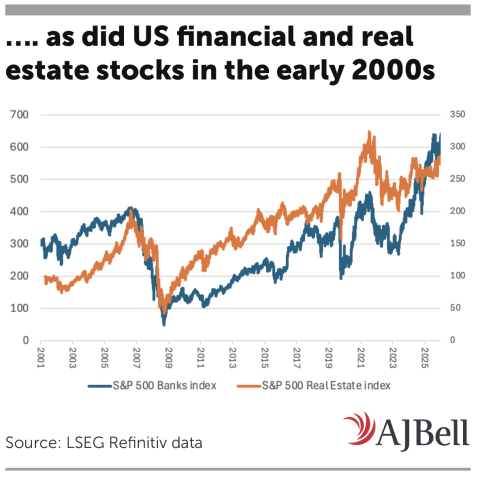
Bears will growl about malinvestment to match the Japanese property bubble of the 1980s, the global internet bubble of the 1990s and US real estate boom of the early 2000s, and this remains a risk. An investment bust to match those could have deleterious consequences for the real economy as well as the financial one, where any downturn could play to the naysayers’ fears a bubble is forming.
Booms and busts
After Space X’s soaraway debut, 13 of the world’s 14 biggest firms by stock market capitalisation are technology or AI related. Such a skew does seem reminiscent of prior episodes where one industry, sector or group of companies fired investors’ imaginations and came to dominate sentiment and stock market indices as a result. Others include the ‘onics and ‘tronics stocks of the late 1960s in the US; America’s Nifty Fifty in the early 1970s; technology, media, and telecom stocks worldwide in the late 1990s; and residential real estate and mortgage-lending specialists in the early 2000s.
All of those were rewarding for supporters during the boom and deeply painful during the subsequent bust. Spotting the turning points is the hard bit. Anyone went bearish on the technology-laden Nasdaq Composite in June 1999 at 2,500, on the grounds it had shot up by 70% in nine months, eventually looked pretty smart, given how the index bottomed at 1,114 in autumn 2022 and took until 2015 to recapture its eventual high. But in the meantime, the benchmark motored from 2,500 to a peak of 5,048 in March 2000 to leave any bears looking very foolish for another nine months, while the internet, mobile telecoms technology and semiconductors eventually delivered everything of what investors thought they were capable – and then so much more besides.
Checklist
Market timing is a fiendish business, as noted by another retired money management titan, Fidelity Magellan fund’s Peter Lynch, when he asserted: “Far more money has been lost by investors preparing for corrections, or trying to anticipate corrections, than has been lost in corrections themselves.”
Selling everything in a particular asset class and then buying it all back is not practical, for reasons of expense, liquidity, and tax, as well as market timing. But exposures can be flexed to calibrate risk, protect wealth, and potentially augment it, so investors might like to use this checklist as a guide to where they think tech and AI stocks, and equities more generally, may be in this particular upcycle.
It is presented without comment, but classic developments in the later stages of an equity bull market – and especially a bubble – can include the following:
- Stock indices that are heavily skewed toward a select band of strongly performing or in-favour companies or sectors
- Companies change their name so they can jump on the hot-sector bandwagon
- Looser accounting standards and greater acceptance of companies’ own preferred profit metrics and ‘EBBS’ (earnings before bad stuff)
- A lowering of the accepted standards of corporate governance and executive conduct in the pursuit of profit
- A rash of new stock market initial public offerings (IPOs) and then follow-on share; sales by management or early-stage backers in (often loss-making) companies
- Stock splits
- Brokers and bankers use increasingly inventive valuation methodologies to justify current share prices and further increases in them
- Launches by, and leaps in assets under management at, new investment funds or products which specialise in fashionable market areas
- Advertising during media coverage of major global events is dominated by a particular hot and fashionable industry or group of companies
- Financial markets move from the middle-to-back sections of newspapers, magazines and website and up to the front

Russ Mould: Investment Director
Russ Mould is AJ Bell's Investment Director. He has a Master's degree in Modern History from the University of Oxford and more than 30 years' experience of the capital markets.
He started out at Scottish...