
Worried about rising rates? These UK stocks offer generous dividends and growth


Related
news
Shares Magazine
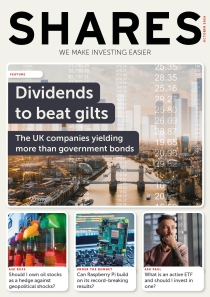
UK 10-year bond yields have reached their highest levels since 2007, while longer-term yields rose to their highest since 1998. When government bonds offer investors more than 5% the stock market has a potential problem.
That’s because rising bond yields represent increasing competition for investors’ money. Higher yields also put pressure on stock valuations, especially growth stocks where earnings growth is expected far into the future.
Why take the extra risk of owning shares when you can earn an attractive return from lending money to the government?
Some UK companies are offering a combination of below average valuations, dividends yields above offer UK 10-year bond yields, and near-term profits growth.
These types of stocks are not always the ones with the greatest quality or the most sustainable earnings, so it is important to make sure you understand the risks.
It might seem obvious, but it is important to steer clear of highly indebted companies which could struggle if borrowing costs remain high.
Remember, dividends are discretionary and therefore not contractual payments like bond interest, which means they can be cut or dropped without warning.
How did we create the list of stocks?
We crunched the numbers to identify UK stocks with a forecast price to earnings or PE ratio below that of the wider market which also have a premium dividend yield compared with current 10-year government bonds.
We also wanted to capture stocks which are expected to grow earnings over the next year.
As ever with stock screening, the resulting list of names is just a starting point for conducting further research.
These companies have valuations, income and earnings characteristics which could, in theory, provide some protection against the changing investment environment.
Tobacco titans on the list
The largest companies by market value on the list are tobacco firms Imperial Brands and British American Tobacco, which are both cash generating businesses due to low capital expenditure needs, and pricing power.
The market’s concern about their long-term growth prospects mean they trade at a PE discount. This has been an advantage for management who have been able to execute share buyback programmes on top of paying juicy dividends.
British American Tobacco trades at a premium valuation to Imperial reflecting its larger scale and a perception that it has built a stronger ‘new categories’ tobacco portfolio.
New chapter beckons for ITV
ITV has become an interesting situation since the proposed sale of its Media and Entertainment business to Sky, which will change its business profile significantly, when it completes in 2027, subject to regulatory approval.
Historically, investors valued the company as a broadcaster exposed to the challenging UK advertising market, but following the sale ITV will become predominantly a global television production company.
ITV Studios is benefiting from international demand for content, streaming platforms and has the potential to further monetise its intellectual property.
ITV expects to receive around £950 million of net cash from the sale of M&E and has already begun returning cash through a £100 million share buyback.
Insurers offering big dividends
Legal and General has one of the highest yields in the FTSE 100 at around 8%, reflecting market concerns around the complexity of its balance sheet and the predictability of surplus cash flows.
Core operating earnings per share increased 11% in the first half of 2026, driven by its pension risk transfer business and a strong recovery in asset management fee-related earnings.
The company has a target to grow the dividend by 2% a year to from 2025 to 2027 and to grow operating cash flow by around 9% a year.
Management believes this dynamic will allow the company to rebuild dividend cover (operating earnings per share to dividend) over time. Analysts at Jefferies have questioned the sustainability of the dividend.
The group is targeting more than £5bn of shareholder returns between 2025 and 2027, including dividends and buybacks. It has also completed approximately £450m of its £1.2bn buyback programme.
Aviva's acquisition of Direct Line has made it the UK’s largest multiline insurer, providing it with greater scale in motor and home insurance. The company increased its interim dividend by 7% to 14p per share.
The insurer has a target to growth operating earnings faster than the dividend, supported by synergies from Direct Line and a growing wealth management business.
Domino’s Pizza on recovery path
UK’s largest pizza Domino’s has a relatively stable cash flow stream, generated by predictable royalty income from its franchised estate, and modest capital expenditure requirements.
First half results showed like-for-like sales growth of 4.9% and a 3.6% increase in underlying core profit driven by an uplift in demand related to the FIFA World Cup.
Underlying free cash flow rebounded to £50.2 million, reflecting higher profitability and improved working capital. The dividend was hiked by a modest 2.8% to 3.7 pence per share.
Dominos retains a progressive dividend policy, aiming to pay out roughly two thirds of earnings per share, with a focus on organic growth and debt reduction.

Martin Gamble: Shares and Markets Writer
Martin Gamble is Shares and Markets writer at AJ Bell. He was previously the Education Editor of Shares Magazine. He has been with the business since 2019.
Martin graduated from the University of Kent in...